

In the Chemical Engineering world what does a Process Engineer do
In this article, we explain what a process engineer is. Sure, a quick Google search will give you a perfect definition, but today ChemEngZone shares what the role is actually like from real, lived experience.
Many might think that the day-to-day work of a process engineer is just about designing and optimizing chemical processes. While this is conceptually true, it fails to capture the actual technical execution and the structural demands of the role. For anyone entering the industry as a chemical engineer, understanding this practical reality is essential.
At ChemEngZone, we look beyond the theoretical definition to analyze what a Process Engineer actually does.
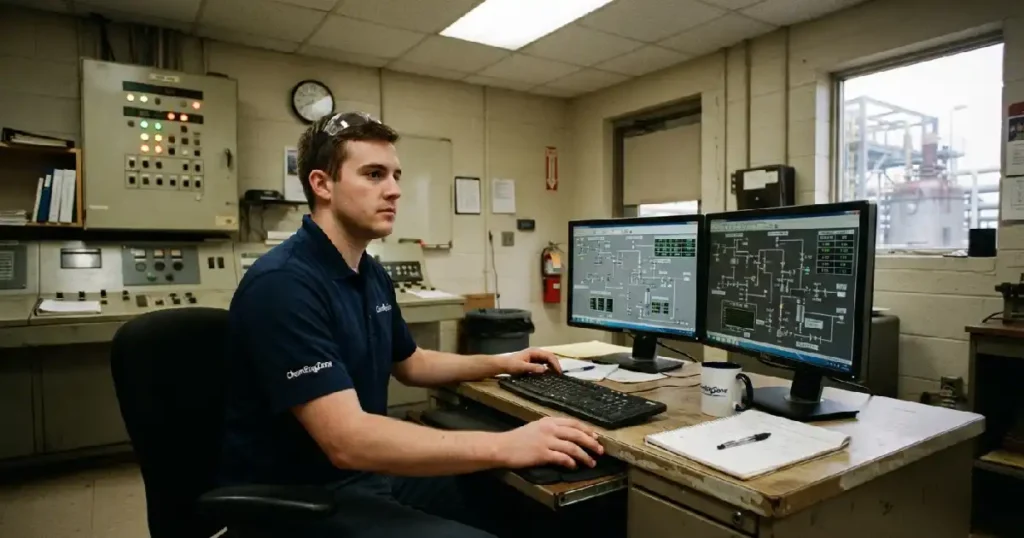
The Core Focus: Bridging the Gap Between Design and Automation
Every specialization within a chemical plant has a precise and critical scope. A Process Safety specialist, for example, focuses heavily on defining safe operating envelopes, interlocks, and layers of protection. However, once the safety parameters and operating philosophies are established, the Process Engineer is the professional who translates these concepts into actual system behavior.
In modern industrial facilities, process engineering is deeply intertwined with automation. The process engineer is directly responsible for working on the software side, configuring the DCS (Distributed Control System) or the PLC (Programmable Logic Controller).
This task involves:
- Developing Process Recipes: Structuring the sequential batch operations and phase logics required to manufacture specific products.
- Configuring Control Loops: Calibrating flow controllers, temperature cascades, and pressure valves to ensure steady-state operation.
- System Integration: Ensuring that the digital brain of the plant perfectly mirrors the Piping and Instrumentation Diagrams (P&IDs).
The Desk vs. Field Misconception: Real-World Time Constraints
A common misconception—often reinforced by generalized management models or theoretical approaches—is that a Process Engineer splits their time evenly between the desk and field inspections. In actual industrial environments, the reality is driven by tight execution timelines and the sheer complexity of the digital systems.
When you are deeply immersed in a project, building and programming complex multi-step process recipes, managing thousands of signals, and resolving technical bottlenecks, the workstation consumes almost the entire day. The cognitive and administrative load of ensuring that the plant’s automation runs flawlessly within a standard 8-hour shift means that field availability becomes highly restricted. There is simply no material time left to physically walk down to the plant floor to verify if a specific control valve or instrument has been installed in the exact optimal position.
However, the core advice from ChemEngZone is to fight this constraint: even when you feel you have absolutely no time, you must find a way to go out into the field. Stepping away from the monitor to see the physical steel, pipes, and valves gives you a massive competitive advantage. It bridges the gap between digital logic and physical reality, allowing you to develop a critical professional skill: the ability to truly “read the plant.”
Conclusion
At the end of the day, a Process Engineer is not just someone who programs batch recipes. Anyone in automation can write code, but a Process Engineer actually understands the process behind it.
To do this effectively, you need to work hand-in-hand with MST (Manufacturing Science & Technology). You don’t need to get bogged down in deep, lab-level reaction chemistry—that’s their job—but you have to understand the process well enough to bridge the gap with plant operations.
What truly defines a good Process Engineer is knowing the physical plant and its purpose: walking down a line, seeing a specific valve in a specific spot, and knowing why it was placed there and what function it serves. Combining DCS skills, close collaboration with MST, and real field awareness is what ultimately allows you to “read the plant.”
⬆️ Back to TopProcess Engineering Reality Quiz
A Process Engineer spends an entire shift configuring complex batch recipes on the DCS, leaving almost no time to walk out to the unit. According to ChemEngZone, what truly defines a great Process Engineer in a real plant?
Other Articles You May Find Useful
- What is a Chemical Engineer
- What Does a Chemical Engineer Do in Industrial Environments?
- Career Opportunities in Chemical Engineering
External Reference: ISA – International Society of Automation (Standards and resources for industrial automation and process control)