
What Is Entropy in Thermodynamics? An Engineering Explanation
Many explanations describe entropy as a measure of disorder. While this interpretation is not entirely wrong, it often leaves engineers with more questions than answers.
Entropy is a thermodynamic property that quantifies irreversibility and the degradation of energy quality in a process.
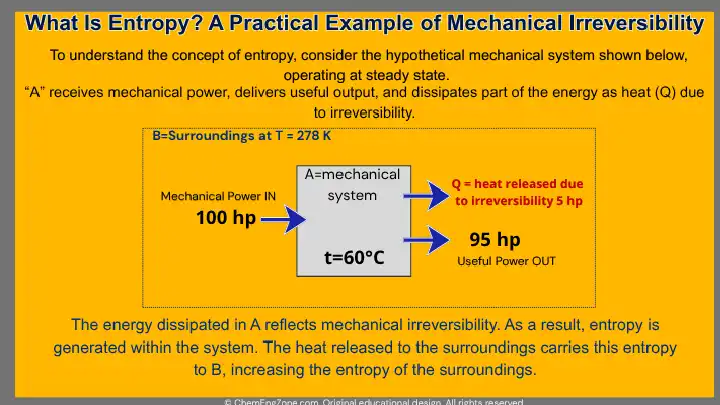
Consider a simple example (Fig 1).
A mechanical system operating at steady state receives 100 hp of mechanical power and delivers 95 hp of useful mechanical power.
Where did the remaining 5 hp go?
The First Law of Thermodynamics tells us that energy cannot disappear. Therefore, the missing 5 hp must still exist in some form.
Answering this question provides one of the most practical ways to understand entropy.
Understanding Entropy Through a Simple Mechanical System
Consider again the mechanical system shown in the figure (Fig.1).
The system receives 100 hp of mechanical power and delivers 95 hp of useful mechanical power. The remaining 5 hp are released to the surroundings as heat.
From an energy balance perspective, nothing unusual has occurred. The total incoming power is equal to the total outgoing power:
100 hp = 95 hp + 5 hp
This observation is fully consistent with the First Law of Thermodynamics, which states that energy cannot be created or destroyed.
However, the First Law alone does not explain the complete picture.
The useful mechanical power entering the system has a high ability to perform work. It can drive a pump, rotate a shaft, compress a gas, or operate industrial equipment.
As the power passes through the system, part of it is degraded by friction and other mechanical losses. The degraded portion leaves the system as heat.
Although the amount of energy remains unchanged, its usefulness has changed. This distinction is fundamental.
Mechanical work can generally be converted into other forms of energy with very high efficiency. Heat released to the surroundings, on the other hand, has a much lower capacity to be converted back into useful work.
As a result, the 5 hp dissipated as heat are not as valuable as the original 5 hp of mechanical power entering the system.
This degradation of energy quality is the consequence of irreversibility.
The friction occurring within the system is an irreversible process. Once mechanical energy has been dissipated as heat, it cannot be completely recovered and converted back into useful work.
Every real engineering system contains irreversibilities. Friction in rotating equipment, pressure losses in pipes, turbulence in flowing fluids, and heat transfer across finite temperature differences are all examples of irreversible processes.
These irreversibilities generate entropy. For this reason, entropy is closely associated with the degradation of energy quality and the loss of useful work potential in real systems.
Why Energy Conservation Is Not Enough
The previous example shows that the total amount of energy remains constant.
The system receives 100 hp of mechanical power and releases a total of 100 hp in the form of useful work and heat.
From the perspective of the First Law of Thermodynamics, the analysis is complete. Energy has been conserved. However, engineers quickly realize that knowing the energy balance alone is often not sufficient.
Consider two situations:
- A system that converts 100 hp of mechanical power into 99 hp of useful work.
- A system that converts 100 hp of mechanical power into only 50 hp of useful work.
In both cases, the First Law is satisfied because energy is conserved. Yet the two systems clearly do not perform in the same way.
The first system makes better use of the available energy, while the second wastes a much larger portion through irreversible effects.
The First Law tells us how much energy enters and leaves a system. It does not tell us how effectively that energy can be used.
This limitation becomes particularly important in engineering applications:
- A pump may consume power while generating pressure losses.
- A heat exchanger may transfer heat through a large temperature difference.
- A control valve may reduce pressure without producing any useful work.
In each case, the total energy remains conserved, but part of its ability to perform useful work is lost.
To understand these limitations, a second principle is required. This principle is known as the Second Law of Thermodynamics.
While the First Law deals with energy conservation, the Second Law deals with energy quality and process direction.
It explains why friction always dissipates energy, why heat naturally flows from hot regions to cold regions, and why no real machine can operate with perfect efficiency.
The concept that allows engineers to quantify these effects is entropy.
Entropy therefore complements the First Law.
The First Law answers the question: How much energy is present?
The Second Law answers a different question: How much of that energy can actually be converted into useful work?
This is why entropy is one of the most important properties in thermodynamics.
Without entropy, it would be impossible to distinguish between an ideal reversible process and a real process affected by irreversibility.
Entropy Generation and Irreversible Processes
The key idea behind entropy is irreversibility.
A reversible process is an ideal process that can be reversed without leaving any change in either the system or the surroundings.
In practice, such a process does not exist. All real processes contain irreversibilities.
Returning to the previous example, the loss of 5 hp is caused by mechanical friction and other dissipative effects occurring inside the system.
These effects convert part of the useful mechanical energy into heat. Once this conversion has occurred, the original mechanical energy cannot be completely recovered. The process has therefore become irreversible.
The Second Law of Thermodynamics states that every real irreversible process generates entropy.
In other words, entropy provides a way to quantify the thermodynamic penalty associated with irreversibility.
One of the most important entropy formulas used in thermodynamics is the entropy generation equation:
Sgen > 0
This entropy equation indicates that every real process generates entropy. For a perfectly reversible process, the entropy generation formula becomes:
Sgen = 0
This distinction is fundamental. Entropy is not generated simply because energy is transferred.
Entropy is generated because the transfer occurs through irreversible mechanisms.
For example:
- Friction generates entropy.
- Turbulence generates entropy.
- Fluid mixing generates entropy.
- Heat transfer across a finite temperature difference generates entropy.
- Pressure losses in pipes generate entropy.
The greater these irreversible effects, the greater the entropy generation.
This is why engineers often associate entropy generation with inefficiency.
Whenever useful energy is degraded into a less useful form, entropy is generated.
The concept applies not only to mechanical systems but to virtually every industrial process.
A pressure drop across a control valve, a friction loss in a pipeline, heat transfer between two streams at different temperatures, or mixing operations inside a process unit are all examples of entropy generation occurring in everyday plant operation.
What Is Entropy? Final Interpretation
Returning to the mechanical system presented at the beginning of this article, the missing 5 hp were not destroyed.
The First Law of Thermodynamics tells us that energy is conserved. The energy simply left the system in a different form.
However, the original mechanical energy was partially degraded into heat through irreversible processes such as friction and dissipation.
This is the key idea behind entropy.
Entropy helps engineers understand that not all forms of energy are equally useful. While the total amount of energy remains constant, its ability to perform useful work can decrease as a result of irreversibility.
For this reason, entropy can be viewed as a measure of irreversibility and energy degradation in real processes.
The greater the irreversibility, the greater the entropy generation.
Whether we are analyzing a pump, a compressor, a heat exchanger, a control valve, or an entire chemical plant, the same principle applies: real processes generate entropy because real processes are never perfectly reversible.
Understanding entropy is therefore not simply a theoretical exercise. It is a fundamental step toward understanding the limitations, efficiency, and behavior of real engineering systems.
⬆️ Back to TopEntropy Quiz
In the mechanical system discussed in this article, 100 hp enter the system and 95 hp leave as useful work. What does the remaining 5 hp represent?
Other Articles You May Find Useful
- The 4 Laws of Thermodynamics
- Work in Thermodynamics. PV Diagrams
- Unit Operations in Chemical Engineering: Types and Examples
- How Distillation Works: Engineering Explanation
- Chemical Engineering Core Disciplines – A Practical Overview
FAQ
Can Entropy Decrease?
Yes, the entropy of a system can decrease under certain conditions. However, the decrease must be accompanied by an equal or greater increase in the entropy of the surroundings. According to the Second Law of Thermodynamics, the total entropy of an isolated system cannot decrease.
Does Every Real Process Generate Entropy?
Yes. Every real process contains irreversibilities such as friction, turbulence, mixing, pressure losses, or heat transfer across a finite temperature difference. These irreversible effects generate entropy.
Is Entropy a Form of Energy?
No. Entropy is not a form of energy. It is a thermodynamic property that helps describe the irreversibility of a process and the degradation of energy quality. While energy is conserved, entropy may be generated.
What Are the Units of Entropy?
The SI unit of entropy is joules per kelvin (J/K). For engineering calculations, specific entropy is often expressed as joules per kilogram-kelvin (J/(kg·K)) or kilojoules per kilogram-kelvin (kJ/(kg·K)).
What Is the Difference Between Entropy and Enthalpy?
Enthalpy measures the energy content of a system, while entropy measures the degree of irreversibility associated with a process. Enthalpy is commonly used in energy balances, whereas entropy is used to evaluate process efficiency and the limitations imposed by the Second Law of Thermodynamics.