
What Is the Darcy-Weisbach Equation?
The Darcy-Weisbach equation is a general relation used to estimate pressure losses caused by friction in internal pipe flow.
The figure illustrates a simple but important concept: as the fluid flows through the pipe, part of its mechanical energy is dissipated due to friction. This energy loss appears as a pressure drop between P₁ and P₂.
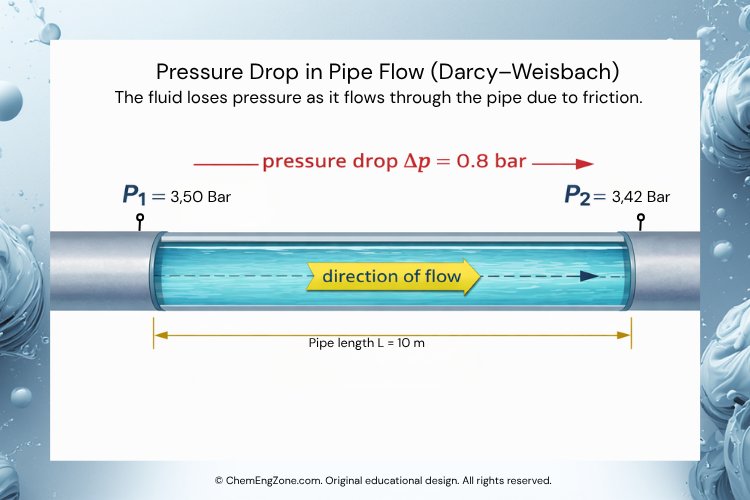
The Darcy-Weisbach equation links this pressure drop to the mechanical energy dissipated along the flow path. It can be applied over a wide range of operating conditions because its structure remains valid across different flow regimes, provided that the friction factor is evaluated correctly.
Darcy-Weisbach Equation for Pipe Pressure Drop
For incompressible flow in a straight pipe, pressure loss due to friction is commonly expressed by the Darcy-Weisbach equation:
where ΔP is the pressure drop, is the Darcy friction factor, is the pipe length, is the internal pipe diameter, is the fluid density, and is the average flow velocity.
This form shows clearly which variables control the result. Pressure drop increases with pipe length and with flow velocity, and it becomes more severe as the pipe diameter decreases. The equation also shows why friction factor is such an important term: it is the parameter that reflects the hydraulic behavior of the flow and links the calculation to Reynolds number and pipe roughness.
In practical terms, this means that pressure loss is not controlled by one variable alone. A short pipe with high velocity may generate a significant loss, just as a long pipe with moderate flow can become critical if the diameter is too small or if the system includes many local restrictions. For this reason, the Darcy-Weisbach equation is widely used not only for line design, but also for pump checks, troubleshooting, and evaluation of system modifications.
Why Is Darcy-Weisbach Different from the Hagen–Poiseuille Equation?
At this point, a natural question arises:
if pressure drop can be calculated analytically using the Hagen–Poiseuille equation, why is the Darcy-Weisbach equation needed?
The Hagen–Poiseuille equation is derived from the Navier–Stokes equations and provides an exact solution for fully developed laminar flow in a circular pipe. It directly relates pressure drop to flow rate, viscosity, and pipe geometry, but its validity is limited to clearly laminar conditions, commonly below about Re = 2300 in internal pipe flow.
By contrast, the Darcy-Weisbach equation is not restricted to a single flow regime. It is a general engineering formulation based on mechanical energy balance, while the influence of flow regime is introduced through the friction factor. This makes it applicable to laminar, transitional, and turbulent flow, provided that the friction factor is evaluated appropriately.
Friction Factor: The Parameter That Controls Pressure Loss
The Darcy-Weisbach equation is general, meaning that it can be applied across different flow regimes and operating conditions. However, its accuracy depends entirely on how the friction factor is evaluated.
The friction factor represents the resistance to flow caused by the interaction between the fluid and the internal surface of the pipe. It accounts for how mechanical energy is dissipated along the flow path due to viscous effects and wall friction.
In particular, the friction factor depends on two key parameters:
- the Reynolds number, which defines the flow regime
- the relative roughness of the pipe, expressed as
While the Darcy-Weisbach equation itself is straightforward, the correct estimation of the friction factor requires an understanding of flow behavior and pipe conditions.
Depending on the flow regime, different approaches are used to evaluate the friction factor, ranging from simple analytical expressions in laminar flow to empirical correlations in turbulent conditions.
From Pipe Friction to Total Pressure Loss
The Darcy-Weisbach equation gives the pressure loss due to friction along a pipe section. This is the starting point of the calculation, but it is not the whole hydraulic picture.
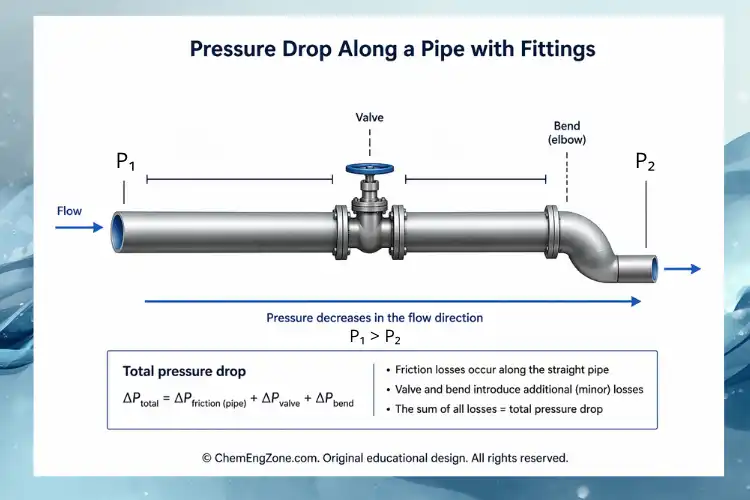
In a real piping system, the fluid does not simply move through a straight pipe. It passes through bends, valves, reducers, filters, instruments, and other restrictions. Each of these elements disturbs the flow and dissipates additional mechanical energy.
For this reason, an engineer should not read the Darcy-Weisbach equation as a calculation isolated from the rest of the system. The equation explains the friction loss along the pipe, but the complete pressure drop depends on the full hydraulic path.
Total Pressure Loss in a Real Piping System
In practice, the total pressure loss is obtained by combining the main contributions along the line:
ΔPtotal = ΔPpipe + ΔPminor + ΔPelevation
Here, ΔPpipe represents the distributed friction loss along the pipe. ΔPminor represents the local losses caused by valves, bends, fittings, reducers, filters, instruments, and other restrictions. ΔPelevation represents the static pressure contribution associated with changes in elevation.
This last term requires particular attention. Elevation is not always a loss in the strict sense. If the line rises, the system requires additional pressure to lift the fluid. If the line descends, gravity may assist the flow and partially compensate for friction and local losses.
This is why pressure drop calculations should never be reduced to one formula used mechanically. The calculation must follow the actual line configuration: pipe length, diameter, fittings, valves, elevation changes, and operating flow rate. Only then does the result become useful for pump sizing, troubleshooting, or checking whether a system modification is hydraulically acceptable.
Want to estimate pressure drop for a real piping system?
Use the ChemEngZone calculator to evaluate total pressure losses, including pipe friction, fittings, valves, and elevation effects.
Open Pressure Drop CalculatorConclusion
The Darcy-Weisbach equation is one of the most useful tools for estimating pressure drop in pipe flow because it connects the hydraulic behavior of the system to measurable physical quantities: pipe length, diameter, fluid density, velocity, and friction factor.
However, the equation should not be used mechanically. In a real piping system, pressure loss depends not only on friction along straight pipe sections, but also on valves, bends, fittings, filters, instruments, elevation changes, and the actual operating flow rate.
For this reason, a good pressure drop calculation starts from the Darcy-Weisbach equation, but it must follow the real hydraulic path of the line. This is what makes the calculation useful for pump sizing, troubleshooting, checking system modifications, and understanding whether a piping system can operate as intended.
⬆️ Back to TopDarcy-Weisbach Equation Quiz
In a real piping system, why is the Darcy-Weisbach equation usually only the starting point of a pressure drop calculation?
Other Articles You May Find Useful
- Fluid Dynamics Basics for Engineers
- Bernoulli’s Principle: Equation & Applications
- Bernoulli Principle Example: Venturi Meter
- What Is Entropy? An Engineering Perspective
- Unit Operations in Chemical Engineering: Types and Examples
Useful Engineering References
Pipe Flow – Darcy-Weisbach Formula
Technical explanation of the Darcy-Weisbach equation, Darcy friction factor, Colebrook-White equation, and head loss calculation in pipe flow.
Crane – Flow of Fluids Through Valves, Fittings, and Pipe
Industry reference connected with pressure drop calculations across valves, fittings, and piping components.
FAQ
What is the Darcy-Weisbach equation used for?
The Darcy-Weisbach equation is used to estimate pressure loss or head loss caused by friction in internal pipe flow. In process engineering, it is commonly used for pipe sizing, pump checks, troubleshooting, and evaluation of hydraulic modifications.
Is the Darcy-Weisbach equation valid for turbulent flow?
Yes. The Darcy-Weisbach equation can be used for laminar, transitional, and turbulent flow, provided that the friction factor is evaluated correctly. In laminar flow, the friction factor can be calculated directly from Reynolds number. In turbulent flow, it usually depends on both Reynolds number and relative pipe roughness.
What is the Darcy friction factor?
The Darcy friction factor is a dimensionless parameter used in the Darcy-Weisbach equation to represent flow resistance due to wall friction. It depends on the flow regime, Reynolds number, and, in turbulent flow, pipe roughness. It should not be confused with the Fanning friction factor, which has a different numerical value.
What is the difference between Darcy friction factor and Fanning friction factor?
The Darcy friction factor is four times the Fanning friction factor. This distinction is important because using the wrong friction factor in the Darcy-Weisbach equation can produce a pressure drop result that is wrong by a factor of four.