

Second Law of Thermodynamics
The First Law of Thermodynamics establishes that energy is conserved. Energy can neither be created nor destroyed; it can only be transformed from one form to another.
While this principle provides the foundation for energy balances, it does not explain why real processes have limited efficiency or why part of the available energy becomes less useful during a transformation.
To understand these limitations, consider the mechanical system shown in Figure 1.
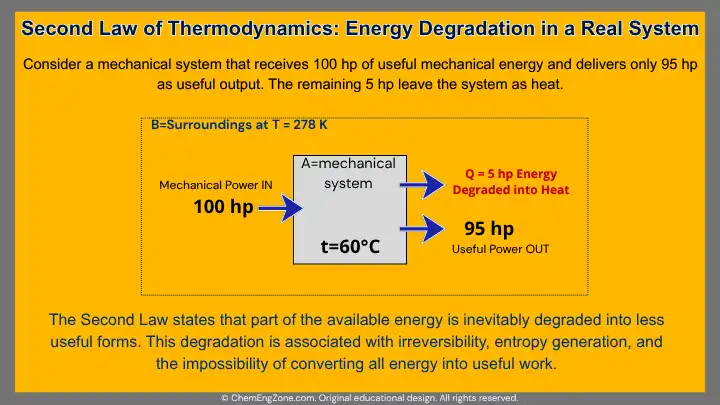
The system receives 100 hp of useful mechanical energy and delivers only 95 hp as useful output. The remaining 5 hp leave the system as heat.
The First Law explains where the energy went: it was not destroyed, but transformed.
However, this immediately raises a new question.
If energy is conserved, why can’t the 5 hp dissipated as heat be completely recovered and converted back into useful work?
Answering this question leads directly to the Second Law of Thermodynamics.
Irreversibility and the Direction of Natural Processes
The inability to fully recover the 5 hp dissipated as heat is not an isolated feature of the system shown in Figure 1.
It is a consequence of a more general principle that applies to all real processes.
Real processes have a preferred direction.
Heat flows spontaneously from hot regions to cold regions (Fig. 2). Friction converts useful mechanical energy into heat. Mixing occurs spontaneously, while complete separation requires external work.
These observations reveal a common characteristic of nature: real processes are irreversible.

Entropy and the Second Law
To formulate the Second Law in a general way, thermodynamics introduces a state property called entropy.
Entropy allows irreversibility to be quantified and provides a mathematical criterion for determining whether a process is reversible or irreversible.
For a reversible process:
where is the entropy change, is the reversible heat transfer, and is the absolute temperature.
For real processes, entropy is generated as a consequence of irreversibility.
This leads to the general form of the Second Law:
Equality applies only to reversible transformations, while the strict inequality applies to irreversible processes.
The presence of entropy generation is what ultimately limits the efficiency of real systems and prevents the complete conversion of heat into useful work. This limitation lies at the heart of the Second Law of Thermodynamics.
Clausius Inequality
The mathematical description of irreversibility leads to one of the most important formulations of the Second Law: the Clausius Inequality.
Among the equivalent formulations of the Second Law, the most general mathematical form is the Clausius Inequality:
Equality holds only for reversible cycles, while real cycles satisfy the strict inequality.
The Clausius Inequality provides a mathematical expression of irreversibility and shows that entropy generation is unavoidable in real cyclic processes.
One important consequence is that no cyclic device can convert all the heat absorbed from a single reservoir into useful work.
Perpetual Motion of the Second Kind
A perpetual motion machine of the second kind is a hypothetical device that would convert heat from a single reservoir entirely into work, operating indefinitely without rejecting heat to a colder sink.
At first sight, such a device does not violate the First Law. The heat absorbed would simply be converted into an equal amount of work, satisfying energy conservation.
The problem appears when the Second Law is considered.
As discussed throughout this article, real processes are affected by irreversibility. Part of the available energy is always degraded into less useful forms, which is why the system shown in Figure 1 could deliver only 95 hp of useful work from 100 hp of available energy.
A machine capable of converting all absorbed heat into work would require the complete absence of entropy generation and irreversibility.
Such a process is impossible.
For this reason, the Kelvin–Planck statement declares:
No cyclic device can transform all the heat absorbed from a single reservoir entirely into work.
Every real heat engine must therefore operate between two reservoirs—a hot source and a cold sink—and must reject part of the absorbed heat. This rejected heat is a direct consequence of the limitations imposed by the Second Law of Thermodynamics.
A machine that attempts to avoid this requirement is not merely impractical; it is fundamentally impossible.
Conclusion
The Second Law of Thermodynamics explains why energy conversion is always subject to limitations.
The system presented at the beginning of this article received 100 hp of useful mechanical energy but delivered only 95 hp of useful output. The remaining 5 hp were degraded into heat as a consequence of irreversibility.
This simple example captures the essence of the Second Law.
Energy is conserved, but not all energy remains equally useful for producing work. Real processes generate entropy, follow a preferred direction, and are subject to efficiency limits that cannot be eliminated.
For this reason, no real machine can convert all available energy into useful work, and no perpetual motion machine of the second kind can exist.
The Second Law therefore defines one of the most fundamental boundaries of engineering: it establishes what is physically possible and what is not.
⬆️ Back to TopSecond Law of Thermodynamics Quiz
Why is a perpetual motion machine of the second kind impossible?
Other Articles You May Find Useful
- Thermodynamics Work in a Transformation
- Bernoulli’s Principle: Equation & Applications
- Fluid Dynamics Basics for Engineers
- Chemical Engineering Core Disciplines – A Practical Overview
- Work in Thermodynamics. PV Diagrams
FAQ
Why is the Second Law important in industrial plants?
Because it sets the maximum achievable efficiency of energy conversion systems. Steam turbines, compressors, and refrigeration units are all constrained by entropy increase. For example, no turbine can convert all heat into work — part of the energy must always be rejected as low-grade heat.
What are the two classical statements of the Second Law of thermodynamics?
Clausius statement: Heat cannot spontaneously flow from a colder body to a hotter one.
Kelvin–Planck statement: No cyclic machine can convert all the heat absorbed from a single reservoir entirely into work.
How does entropy affect process design?
Entropy analysis helps engineers identify irreversibilities (pressure drops, heat losses, friction) and improve efficiency. For instance, in heat exchangers, a minimum temperature difference must always exist; otherwise, heat transfer would stop.
What is the difference between a reversible and an irreversible process?
A reversible process is an idealized transformation that occurs infinitely slowly, with the system always in equilibrium with its surroundings. Entropy change can be exactly calculated as dS=δQrev/T.
In reality, almost all processes are irreversible: friction, heat transfer across finite temperature differences, mixing, and rapid expansions all increase entropy and make the process one-way.
Why does irreversibility matter in industrial systems?
Irreversibility sets the practical efficiency limits of real equipment. For example:
A turbine cannot reach the Carnot efficiency because of friction and pressure drops.
Heat exchangers always require a temperature difference to transfer heat, which produces entropy.
Compressors and pumps consume extra power due to mechanical losses.
These irreversibilities explain why no industrial system can convert energy with 100% efficiency.