
Definition and Scope of Chemical Engineering
Chemical engineering is the discipline responsible for designing, analyzing, and operating industrial process systems that transform raw materials into finished products under controlled, safe, and economically viable conditions.
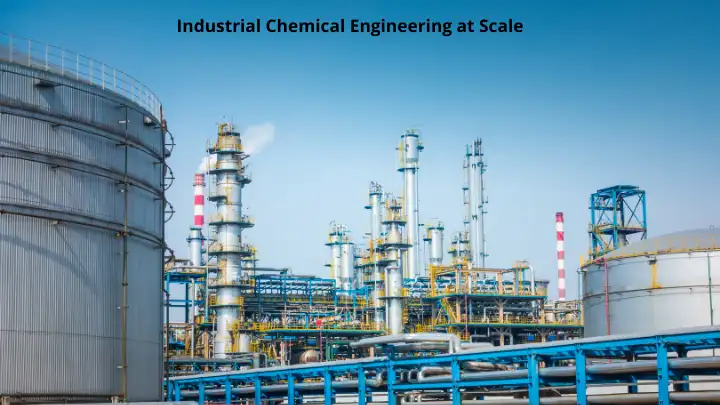
It is not defined by laboratory glassware or isolated chemical reactions.
It is defined by the ability to make complex systems function reliably at industrial scale.
In industrial environments, chemical engineering integrates thermodynamics, fluid mechanics, heat and mass transfer, reaction engineering, control systems, and process safety into coordinated operations. These disciplines do not operate independently; they interact continuously within the same physical system.
From Scientific Knowledge to Industrial Implementation
Chemistry seeks to understand matter and reactions at the molecular level.
Chemical engineering applies that knowledge to real production systems.
The distinction is not theoretical — it is operational.
While chemistry explains how substances behave, chemical engineering determines how those behaviors can be controlled inside reactors, pipelines, distillation columns, storage systems, and heat exchangers operating under defined pressure, temperature, and flow conditions.
The central challenge is implementation under constraint: safety limits, economic performance, environmental compliance, and operational stability.
A Practical Example: Methanol–Water Transfer
Consider a simple operation: transferring methanol from one storage tank into another containing water to prepare a diluted stream for downstream processing.
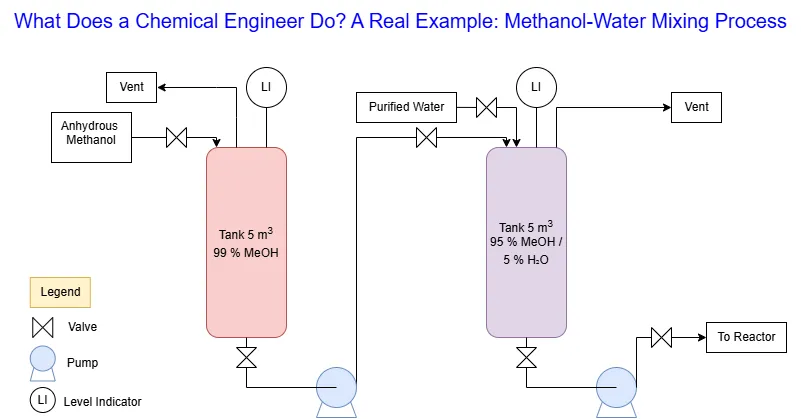
Even in this seemingly straightforward transfer, multiple engineering domains interact simultaneously.
Thermodynamics governs mixture properties such as density, vapor pressure, and phase equilibrium.
Fluid mechanics determines pressure losses along the transfer line based on pipe length, fittings, diameter, and flow regime.
Mass balance calculations define the methanol volume required to achieve the specified concentration.
Materials engineering ensures compatibility between methanol and system components such as seals, gaskets, and piping.
Process safety requires safeguards against dry running, overfilling, vapor release, and potential ignition sources.
The operation is simple only on paper.
In practice, it is a coordinated interaction of physical laws, equipment design, and risk management.
This is chemical engineering.
Core Engineering Disciplines
Chemical engineering is structured around fundamental technical domains:
Thermodynamics
Fluid mechanics
Heat and mass transfer
Reaction engineering
Process control
Process safety
These disciplines form an integrated analytical framework. They enable engineers to predict system behavior, identify deviations, and design corrective measures before failures occur.
A structured overview of these core areas is presented in
Chemical Engineering Core Disciplines – A Practical Overview.
Unit Operations as Industrial Building Blocks
Industrial plants are constructed from standardized physical transformations known as unit operations.
Distillation, heat exchange, absorption, drying, filtration, pumping, and mixing represent recurring functional steps that appear across sectors.
Whether in pharmaceuticals, petrochemicals, food processing, or specialty chemicals, the same physical principles govern system behavior.
Understanding unit operations means understanding how industrial plants are structured.
Equipment and System Responsibility
Chemical engineering is inseparable from equipment.
Reactors must maintain controlled reaction environments.
Heat exchangers must transfer energy within design limits.
Distillation columns must achieve separation specifications.
Relief systems must prevent catastrophic overpressure.
Storage tanks must withstand operational and accidental loads.
Each component exists within a system of interactions. Failure to understand those interactions leads to operational instability and safety risk.
Engineering responsibility lies in anticipating these interactions before they manifest as incidents.
Professional Path and Industrial Role
Chemical engineers operate at the interface between theory and implementation.
Their roles typically evolve within:
Process design and optimization
Plant operations and production
Process safety and risk management
The profession requires structured reasoning, technical judgment, and accountability. Decisions taken at the design or operational level directly influence safety performance, plant reliability, and economic outcomes.
A detailed exploration of professional roles is available in
What Does a Chemical Engineer Do?
and
Career Opportunities in Chemical Engineering.
Conclusion
Chemical engineering is not defined by a specific industry, product, or job title.
It is defined by the ability to understand how industrial systems behave, how they may deviate from intended operation, and how to design processes that remain stable, efficient, and safe under real constraints.
It is the discipline that transforms scientific knowledge into controlled industrial reality.
⬆️ Back to TopOther Articles You May Find Useful
- Chemical Engineering Core Disciplines – A Practical Overview
- Unit Operations in Chemical Engineering: Types and Examples
- Fluid Dynamics Basics for Engineers
- The 4 Laws of Thermodynamics
- What Is HAZOP Analysis? Example and Template
FAQ
What Can You Do With a Chemical Engineering Degree?
You can work in industries like energy, pharmaceuticals, food, environment, or finance—doing anything from process design and R&D to sustainability, project management, or data analysis.
Is Chemical Engineering a good major?
Yes — it’s a valuable and versatile STEM degree that opens doors to high-demand fields like energy, pharma, environment, and materials, while building strong problem-solving and interdisciplinary skills.
Why is Chemical Engineering important?
Because it has a major impact on people’s lives — from producing life-saving medicines and clean water to developing sustainable energy and safer industrial processes. It transforms science into practical solutions that shape the world around us.
Is Chemical Engineering dangerous?
Not when proper safety measures are followed. While it may involve working with hazardous substances, chemical engineers are trained to design safe systems, conduct risk assessments (like HAZOP), and apply strict safety protocols. Most work takes place in controlled environments such as labs, offices, or monitored plants.
Is Chemical Engineering a bachelor of science?
Yes, it’s usually offered as a B.Sc. degree, combining chemistry, physics, math, and engineering subjects like thermodynamics and process control.
Is Chemical Engineering hard?
Yes, it’s challenging due to advanced math, chemistry, and system design—but it’s also rewarding and highly valued in industry.
Why study chemical engineering
It offers global career opportunities, strong salaries, and real-world impact—solving challenges in energy, sustainability, and production through science and engineering.