

What are Unit Operations?
Unit operations in chemical engineering are the fundamental physical steps used to transform materials without changing their chemical composition. Heating, cooling, separating, mixing, filtering, and transporting are recurring functions across industrial plants, regardless of product or sector.
These operations form the basis of process design in all chemical plants, from small-scale production to large industrial facilities.
Main Unit Operations
The main unit operations can be grouped into four fundamental categories:
- Heat transfer operations (temperature control and energy exchange)
- Mass transfer operations (separation and purification processes)
- Mechanical operations (solid handling and physical separation)
- Fluid transport operations (movement and control of fluids)
Heat Transfer Operations
Heat transfer operations are used whenever a process requires controlled heating, cooling, evaporation, condensation, or energy recovery. In industrial plants, these operations affect reaction temperature, phase change, separation performance, utility demand, and operating stability.
Although the underlying mechanisms remain conduction, convection, and radiation, engineering decisions are usually driven by process duty, temperature approach, fouling tendency, pressure constraints, and available utilities.
Typical equipment includes shell-and-tube heat exchangers, plate heat exchangers, double-pipe exchangers, condensers, reboilers, and evaporators.
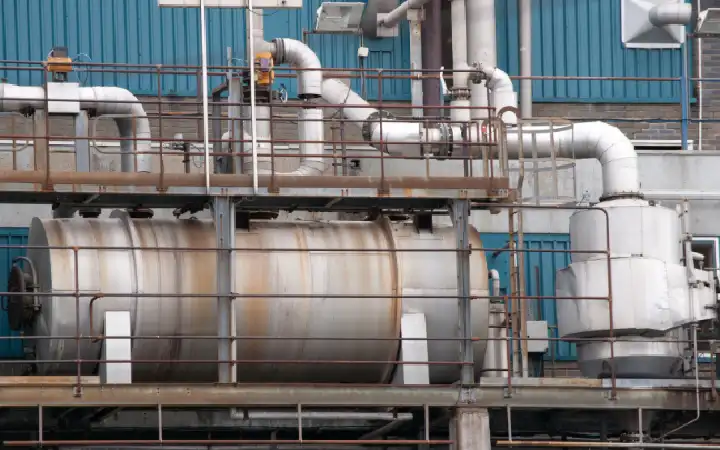
Main Heat Transfer Operations
Sensible Heating and Cooling
This operation is used to raise or lower the temperature of a process stream without inducing a phase change. It supports temperature control in reactions, separations, and feed conditioning.
→ Typical equipment: shell-and-tube heat exchangers, plate heat exchangers, double-pipe heat exchangers
Boiling / Reboiling
Boiling or reboiling provides the latent heat required to convert liquid into vapor. It is typically used in distillation columns and flash vessels to drive phase separation.
→ Typical equipment: reboilers (kettle, thermosyphon, forced-circulation types)
Condensation
Condensation converts vapor into liquid, usually to recover solvents, generate reflux, or reduce emissions. It is the reverse of boiling and is essential in many closed-loop process systems.
→ Typical equipment: condensers (vertical, horizontal, air-cooled, or water-cooled)
Evaporation and Concentration
This operation removes water or solvents by converting them into vapor, thereby increasing the concentration of the remaining solute. It is widely applied in purification, drying, and pre-crystallization stages.
→ Typical equipment: falling-film evaporators, rising-film evaporators, forced-circulation evaporators
Mass Transfer Operations
Mass transfer operations are used when a process requires the separation, purification, or recovery of one or more components from a mixture. In industrial practice, these operations are central to solvent recovery, gas treatment, product purification, and concentration steps.
Their performance depends on phase equilibrium, interfacial contact, residence time, and the driving force available for transfer between phases. For this reason, mass transfer operations are closely linked to temperature, pressure, hydraulics, and equipment configuration.
Processes such as distillation, absorption, stripping, extraction, adsorption, membrane separation, and crystallization belong to this family, although their industrial applications may differ significantly.
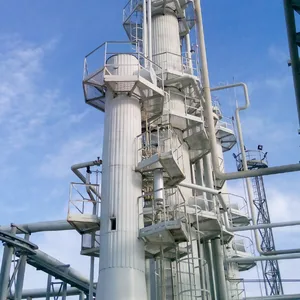
Main Mass Transfer Operations
Distillation
Distillation separates components in a mixture based on differences in volatility. It relies on vapor–liquid equilibrium and is widely used in petrochemical, pharmaceutical, and food industries.
→ Typical equipment: distillation columns, trays (sieve, valve, bubble cap), structured packing, reboilers, condensers
The operating principles of distillation, from flash vaporization to staged columns, are discussed in detail in How Distillation Works.
Absorption
Absorption transfers a gas-phase solute into a liquid solvent, typically for gas purification or contaminant removal.
→ Typical equipment: packed towers, tray columns, spray columns, gas scrubbers
Stripping
Stripping removes volatile components from a liquid by contacting it with a gas, usually steam or air. It is essentially the reverse of absorption.
→ Typical equipment: stripping columns, steam strippers, packed towers, tray columns
Liquid–Liquid Extraction
This operation separates solutes based on their solubility in two immiscible liquid phases. It is used when distillation is ineffective or thermally unsuitable.
→ Typical equipment: mixer-settlers, rotating disc contactors, pulsed columns, centrifugal extractors
Leaching (Solid–Liquid Extraction)
Leaching extracts solutes from solids using a liquid solvent. It is common in mining, pharmaceuticals, and food processing.
→ Typical equipment: agitated leach tanks, percolators, rotary drum extractors, counter-current extractors
Adsorption
Adsorption captures solutes from a fluid onto the surface of a solid adsorbent, commonly for gas purification or water treatment.
→ Typical equipment: fixed-bed adsorbers, moving-bed systems, activated carbon columns, silica gel beds
Membrane Separation
This operation uses a semi-permeable barrier to separate components based on size, charge, solubility, or diffusivity. It is widely used in water treatment, pharmaceuticals, biotechnology, and fine chemical processing. Although membrane systems are often treated as a distinct technological group, they are fundamentally related to mass transfer because separation occurs through transport across a membrane.
→ Typical equipment: microfiltration units, ultrafiltration modules, nanofiltration systems, reverse osmosis skids, membrane contactors
Crystallization
Crystallization separates solids from a solution by inducing crystal formation through cooling or evaporation. It is critical for purity and product consistency.
→ Typical equipment: batch crystallizers, forced-circulation crystallizers, vacuum crystallizers, draft-tube baffle crystallizers
Mechanical Operations
Mechanical operations are used when the process involves solids, slurries, particle size control, or solid–liquid separation. These operations are essential in many plants because solids handling, filtration behavior, settling performance, and particle preparation often determine the stability and practicality of downstream processing.
In contrast to heat and mass transfer operations, the dominant issues here are usually physical handling, particle movement, separation by force or gravity, and the mechanical preparation of materials for the next processing step.
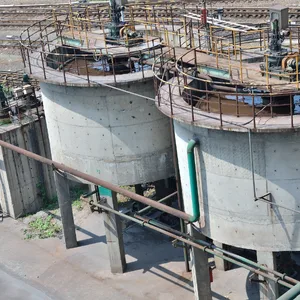
Types of Mechanical Unit Operations
Mixing
Combines solids with liquids (slurries) or blends solid fractions to create a uniform feed for reaction, handling, or separation.
→ Typical equipment: ribbon blender, paddle mixer, high-shear mixer
Filtration
Separates solids from liquids by forcing slurry through a porous medium to form a removable solid cake.
→ Typical equipment: filter press, rotary vacuum filter, membrane filter
Sedimentation
Allows solids to settle by gravity in order to concentrate them or clarify liquid streams.
→ Typical equipment: gravity thickener, clarifier tank
Decantation
Removes the clarified liquid phase without disturbing the settled solids.
→ Typical equipment: decanter, siphon system, overflow weir tank
Centrifugation
Applies centrifugal force to accelerate solid–liquid separation, improving clarity and throughput.
→ Typical equipment: disc-stack centrifuge, decanter centrifuge
Screening
Separates particles based on size to ensure uniformity or remove oversize material.
→ Typical equipment: vibrating screen, rotary trommel, gyratory sifter
Milling
Reduces particle size for better handling or further processing.
→ Typical equipment: jaw crusher, hammer mill, ball mill, pin mill
Dynamic Agitation
Uses mechanical impellers to mix liquids or slurries inside tanks and reactors. It is applied when the process requires concentration uniformity, suspension of solids, improved heat transfer, or support for reaction kinetics.
→ Typical equipment: agitated vessels, Rushton turbines, marine propellers, anchor stirrers, baffles
Fluid Transport Operations
Fluid transport operations are used when liquids or gases must be moved, distributed, or controlled within an industrial system. In chemical plants, these operations determine how process streams are transferred between equipment, how pressure losses are managed, and how stable operating conditions are maintained.
Their performance depends on flow rate, pressure, fluid properties, piping layout, and hydraulic resistance. For this reason, fluid transport operations are closely linked to pump selection, line sizing, valve behavior, and overall process controllability.
Typical equipment includes centrifugal pumps, compressors, control valves, piping networks, and flow measurement devices.
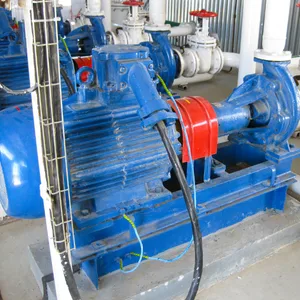
Main Fluid-Transport Unit Operations
Pumping
Pumping involves transferring liquids from one vessel or process section to another at specific flow rates and pressures. The choice of pump depends on fluid viscosity, pressure requirements, flow conditions, and system resistance.
Typical equipment: centrifugal pumps, diaphragm pumps, gear pumps, peristaltic pumps.
Pipeline Transport
This operation refers to the movement of fluids through networks of pipes and fittings, taking into account frictional pressure losses, elevation changes, and flow regimes. Engineers must also consider two-phase flow, material compatibility, and hydraulic stability.
Typical equipment: piping systems, bends, reducers, expansion joints, pipe supports, two-phase separators.
Valve and Flow Control
Fluid streams in industrial systems must be regulated to maintain process stability, safety, and operating flexibility. Flow control involves adjusting velocity, pressure, or direction through a variety of mechanical devices.
Typical equipment: control valves, pressure-reducing valves, isolation valves, orifices, flow meters.
Pneumatic Conveying
This operation is used to transport powders or fine solids through pipelines by means of a high-velocity gas stream. It is commonly applied when dry materials must be moved continuously between equipment or storage points.
Typical equipment: pneumatic conveyors, blowers or compressors, rotary valves, cyclones.
Static Mixing
Static mixing achieves the blending of two or more fluid streams directly within a pipe without moving parts. It is widely used in continuous processes where low-maintenance in-line mixing is required.
Typical equipment: inline static mixers, helical inserts, tab-type mixing elements.
Conclusion
Unit operations remain the backbone of chemical engineering practice. Whether the task involves heat transfer, mass transfer, mechanical operations, or fluid transport, industrial processes can be understood as combinations of these fundamental physical steps.
Ultimately, mastering unit operations means understanding the logic behind process design. It allows engineers across industries, from pharmaceuticals to petrochemicals, from water treatment to food production, to analyze, scale up, and troubleshoot industrial systems with a common technical framework.
⬆️ Back to TopUnit Operations Quiz
Why are unit operations considered the foundation of chemical engineering?
Other Articles You May Find Useful
- What Is Heat Transfer? Definition and Types
- How Distillation Works: Engineering Explanation
- Fluid Dynamics Basics for Engineers
- The 4 Laws of Thermodynamics
- Chemical Engineering Core Disciplines – A Practical Overview
Useful Engineering References
For further technical reading on chemical engineering fundamentals and professional resources, the following references may be useful:
AIChE – American Institute of Chemical Engineers
Professional organization offering technical resources, publications, and industry updates for chemical engineers.
LibreTexts Engineering – Open Educational Resources
Open-access engineering material covering core topics such as transport phenomena, thermodynamics, separations, and unit operations.
FAQ
What is a unit operation with an example?
A unit operation is a physical step where materials undergo changes in state or physical properties without altering their chemical structure. Examples include filtration, distillation, centrifugation, and drying.
(Engineering example )
In wastewater treatment, sludge thickening and dewatering are unit operations used to reduce water content before disposal.
What is the difference between a unit operation and a unit process?
As seen above, a unit operation is a physical step in which materials change state, phase, or physical properties without altering their chemical structure.
Examples include filtration, sedimentation, centrifugation, distillation, and drying.
A unit process, instead, involves a chemical or biological transformation that changes the composition or molecular structure of the material.
Examples include oxidation, chlorination, neutralization, and biological digestion.
Example – Sludge Treatment
In wastewater sludge management, both unit operations and unit processes are applied.
Thickening and dewatering (filtration, centrifugation) are unit operations, while stabilization through biological digestion or chemical treatment is a unit process. Together, they transform high-moisture sludge into a stable residue suitable for safe disposal.
What is a unit operation in pharmaceutical industry?
In the pharmaceutical industry, unit operations include essential steps such as granulation, tablet compression, coating, and sterilization.
Each step ensures that the final drug product meets strict quality and safety standards.
What are unit operations in food processing?
In food processing, several steps can be mapped directly to classical unit operations of chemical engineering.
Examples include:
Pasteurization: heat transfer (controlled heating to inactivate microorganisms),
Freezing: heat transfer (removal of heat until solidification),
Drying: heat and mass transfer (evaporation of water from the product),
Emulsification: mechanical operation (dispersing two immiscible liquids into a stable mixture).
Other steps, such as packaging, are not classical unit operations in the academic sense (as described in Perry’s Handbook), but are considered essential process stages in food engineering because they preserve product quality, safety, and shelf life.