
Already familiar with this topic? Test your understanding here.
Go to the quizWhat Is a Safety Management System (SMS)?
A Safety Management System (SMS) is a structured organizational framework used to systematically manage safety risks within an operation.
It defines how hazards are identified, how risks are evaluated, how controls are implemented, and how safety performance is monitored over time. An SMS integrates engineering safeguards, operating procedures, management responsibilities, and workforce engagement into a coordinated system.
Rather than relying on isolated safety tools, an SMS ensures that risk control activities are planned, documented, verified, and continuously improved throughout the lifecycle of an industrial facility.
What Makes a Safety Management System Effective?
A Safety Management System becomes effective only when it is embedded in daily operational practice and supported consistently across all organizational levels.
Effectiveness is not determined by the existence of procedures, but by the degree to which risk awareness translates into engineering decisions, maintenance planning, operational discipline, and management accountability.
An effective SMS integrates all departments — operations, engineering, maintenance, quality, and HSE — ensuring that safety is not confined to a specialized function but incorporated into core business processes. Training, communication, and leadership engagement must reinforce the system continuously, particularly under production pressure.
Without this integration, safety tools risk becoming formal exercises that generate documentation without delivering measurable risk reduction.
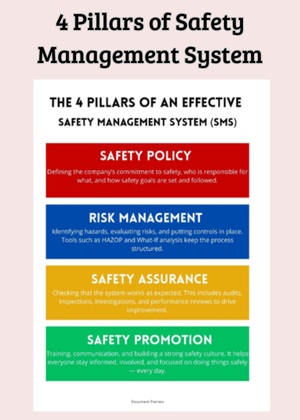
Download the 4 Pillars of a Safety Management System PDF
Access a concise Safety Management System PDF infographic summarizing the four core pillars: Safety Policy, Risk Management, Safety Assurance, and Safety Promotion. Designed for training sessions and internal technical discussions.
Download the Free PDFPillar 1: Safety Policy
Every Safety Management System starts with a clear safety policy.
A safety policy is not just a statement displayed in an office. It defines how safety decisions are made, who is accountable, and how priorities are communicated across the organization.
An effective safety policy includes:
- clear and measurable safety objectives,
- risk-based decision-making criteria,
- visible leadership involvement,
- protection and engagement of employees.
When actively applied, the safety policy aligns production, maintenance, engineering, quality, and management under a shared safety vision. Without it, even good technical tools lose effectiveness.
Pillar 2: Risk Management
Risk management is the operational core of a Safety Management System.
It includes all structured activities aimed at identifying, evaluating, and controlling hazards related to equipment, processes, operations, and human performance. While methodologies such as HAZOP are central to process risk analysis, risk management within an SMS is broader. It also encompasses operational risk assessments, management of change (MoC), human factor considerations, and verification that safeguards remain effective over time.
In other words, risk management is not a single study but a continuous discipline that connects analysis to implementation.
A practical case illustrates this principle:
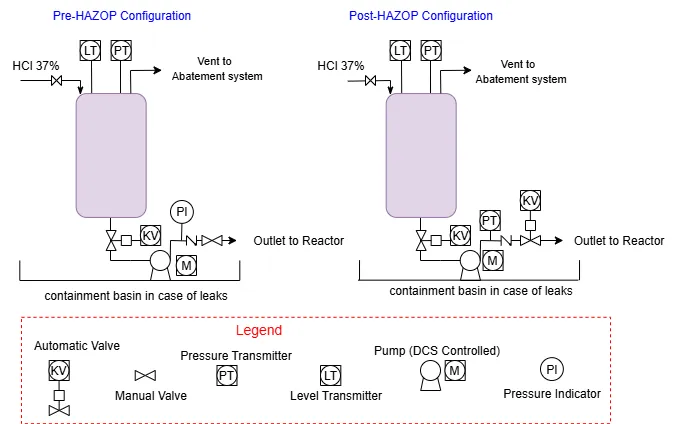
During a transfer operation from a 37% hydrochloric acid storage tank to a reactor, the original configuration required manual valve manipulation inside the containment basin, exposing operators to corrosive vapors. The HAZOP study identified credible deviations, including risks related to manual pump operation, potential leakage, and the absence of interlocks under abnormal pressure conditions.
The analysis led to engineering modifications: installation of an automatic isolation valve upstream of the pump, addition of pressure transmitters for improved monitoring, implementation of interlocks to prevent unsafe transfer, and formalization of the pump start-up sequence to avoid dry running.
The value of the risk management pillar did not lie in the HAZOP report itself, but in the design changes and operational controls that followed.
Pillar 3: Safety Assurance
Safety assurance ensures that the Safety Management System remains effective over time.
This pillar focuses on monitoring performance, verifying the integrity of safeguards, and learning from operational deviations. It includes the systematic use of leading and lagging indicators, near-miss reporting and analysis, internal audits, inspections, and structured follow-up of corrective actions.
A near miss is an event that could have resulted in harm but did not. These events provide early warning signals of system weaknesses. When properly analysed, they reveal latent failures before they escalate into serious incidents.
Safety assurance closes the loop between risk identification and operational performance. It ensures that protective measures are not only designed, but maintained, tested, and continuously improved. In this way, the organization moves from reactive response to disciplined, proactive risk control.
For a deeper understanding of how to manage technology changes rigorously, see the CCPS’s Key Principles of Process Safety for Management of Change (MOC) (January 2024)
Pillar 4: Safety Promotion & Culture
Safety cannot be sustained by procedures alone.
The safety promotion and culture pillar addresses the behavioral and organizational dimensions of risk control. It focuses on ensuring that safety considerations consistently influence everyday decisions, particularly in situations where supervision, time pressure, or production demands may compromise discipline.
A mature safety culture is reflected in transparent communication, continuous training, active reporting of concerns, and leadership behavior that reinforces safe practices through example rather than slogans. Culture determines how individuals act when procedures are unclear, when unexpected conditions arise, or when trade-offs between safety and productivity appear.
Major industrial accidents have repeatedly demonstrated that technically sound systems can fail when organizational behaviors and leadership priorities are misaligned. Safety promotion ensures that the other SMS pillars — policy, risk management, and assurance — remain effective under real operational pressure.
SMS and Regulatory Framework
A Safety Management System (SMS) is more than best practice—in many industries it is a legal requirement that obliges companies to identify, control and continuously reduce risk.
Regional Legal Requirements
• Europe – Seveso III Directive 2012/18/EU mandates a formal SMS for every major-accident-hazard establishment, covering process safety, emergency planning and training.
• United States – OSHA 29 CFR 1910.119 Process Safety Management lists 14 compulsory elements of a compliant safety programme.
• United Kingdom – COMAH Regulations 2015 implement Seveso principles to prevent and mitigate major chemical accidents.
International Standards
• IEC 61511 Functional Safety – Safety Instrumented Systems sets lifecycle requirements for SIS in the process sector.
• API RP 754 Process-Safety Performance Indicators defines Tier 1-to-Tier 4 metrics used worldwide.
• ISO 45001 Occupational Health & Safety Management Systems is the global benchmark that replaced OHSAS 18001.
FOR TRAINING AND CASE STUDIES
The U.S. Chemical Safety Board publishes investigation reports and animations that are excellent material for workshops and toolbox talks.
Conclusion
The four safety management system pillars form an integrated framework that connects policy, risk control, performance monitoring, and human behavior.
When applied together, they turn safety from a formal requirement into a living system that protects people, assets, and the environment. The real value of an SMS lies not in documentation, but in how consistently these pillars guide everyday decisions in the plant.
⬆️ Back to TopSafety Management System Quiz
In a chemical plant, when does a Safety Management System actually reduce risk?
You might also find useful
- What Is HAZOP Analysis? Example and Template
- LOPA & SIL: Practical Examples
- Safety Interlocks: P&ID Example
- Vent Header Design: Safer Top Tie-In Layout
- Pressure Safety Valve vs Rupture Disc: Key Differences
- Vacuum Tank Collapse in Atmospheric Tanks
Useful External Links
CCPS – Center for Chemical Process Safety
Global reference for process safety, risk-based frameworks, and engineering best practices.
UK HSE – Process Safety Guidance
Practical technical guidance on risk control, process safety management, and regulatory expectations.
FAQ
What are the four pillars of a Safety Management System?
Safety Policy, Risk Management, Safety Assurance, and Safety Promotion & Culture. These terms are also used in aviation. In process industries, they match the mandatory chapters of Seveso III and OSHA PSM.
Is a Safety Management System mandatory under the Seveso III Directive?
Yes: every major accident hazard establishment must demonstrate a formal SMS compliant with Annex III of Directive 2012/18/EU.
How does SMS differ from OSHA Process Safety Management?
SMS covers the full cycle: risk–operations–culture. OSHA PSM details 14 technical and documentation elements. In a U.S. plant, SMS encompasses PSM.
What is a near miss in safety assurance?
An event that could have caused damage but didn’t. Analyzing it helps prevent real incidents at minimal cost.
How often should HAZOP studies be repeated?
Generally every 5 years or after each significant modification (MoC), based on CCPS and OSHA guidelines.
Can ISO 45001 replace a process-safety SMS?
No: ISO 45001 covers occupational health and safety. A process-specific standard such as IEC 61511 or API RP 754 is still needed.
What’s the best way to promote safety culture on shift?
10–15 minute micro-trainings, sharing near misses at the start of the shift, and visual slogans on digital dashboards.
Which standard governs Safety Instrumented Systems?
IEC 61511 (or ANSI/ISA 84 in the U.S.) defines the full lifecycle for SIS in the process sector.