

This article highlights practical engineering considerations that help frame the discussion around pressure relief solutions under real process conditions.
Rather than prescribing a fixed choice, it examines how different devices behave during an overpressure event and how aspects such as pressure dynamics, fluid characteristics, system layout, and operational constraints can influence the evaluation.
Using a simplified reactor case, the article illustrates how these factors affect the overall protection philosophy and why the final decision cannot be reduced to a single general rule.
Its purpose is to support engineering reasoning before detailed relief analysis and before the application of relevant design standards such as API 520/521, ASME Section VIII, or ISO 4126.
Pressure Relief Devices for Vapor Service
In this article, the discussion refers specifically to pressure safety valves (PSVs) used for gas or vapor service, not to pressure relief valves (PRVs), which are generally associated with liquid service.
In general, pressure relief devices include:
- pressure safety valves (PSVs), typically used for gas or vapor service and designed to open rapidly at the set pressure;
- pressure relief valves (PRVs), generally used for liquid service and characterized by a modulating opening behavior;
- safety relief valves (SRVs), which may be applied in both liquid and vapor service depending on the application;
- rupture discs (RDs), which are non-reclosing devices designed to burst at a defined pressure.
In this article, however, the discussion is limited to PSVs and RDs applied to vapor service, as these are the most relevant devices for the type of reactor overpressure scenario considered here.
After a brief introduction to the essential theory, this article uses a practical reactor example to discuss how different protection devices behave and to highlight some of the key aspects involved in evaluating relief solutions under real process conditions.
In real chemical plants, this choice directly affects how a reactor behaves during an upset, how quickly pressure is relieved, and whether the system can stabilize after the event.
Operating Principles
Pressure Safety Valve (PSV)
A pressure safety valve (PSV) is a mechanical pressure-relieving device that opens at a defined set pressure to protect equipment from overpressure. Most conventional PSVs are spring-loaded, although pilot-operated designs are also widely used.
Key characteristics:
• Automatically recloses
• Requires periodic maintenance
• Susceptible to fouling, sticking, or leakage
• Can be equipped with position indicators, although rarely installed
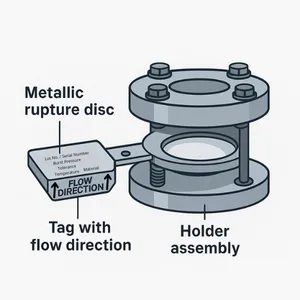
Rupture Disc (RD)
A calibrated membrane designed to open instantaneously once the burst pressure is exceeded.
Key characteristics:
• Immediate response
• Perfect tightness until it bursts
• No moving parts
• Cannot reclose
• Must be replaced after activation
• Easily integrated with burst sensors for immediate DCS signalling
To make these concepts clear, let’s start with a concrete example.
Practical Selection Considerations
Automation and Opening Detection
A standard PSV does not provide an electrical opening signal. Newer valve models equipped with opening sensors are becoming available, but traditionally this feature has not been part of standard installations.
When additional opening-detection devices are installed, it is essential to verify that the valve’s functional reliability is not affected. The primary relief function must remain fully dependable, regardless of any accessory mounted on the PSV.
A rupture disc, on the other hand, can be equipped with a burst detector that generates an immediate and unambiguous signal.
If the plant requires immediate and unambiguous event detection, this can favor the use of a rupture disc.
Fluid Characteristics
• Clean, non-corrosive gases: PSV or RD (both can be suitable depending on tightness requirements or opening characteristics)
• Corrosive, sticky, or polymerizing fluids: rupture discs or combined RD + PSV configurations are often preferred, as they reduce the risk of fouling, sticking, or loss of function in the valve.
• Need for absolute tightness → a rupture disc is generally preferred, since a PSV may allow small leakage over time due to its mechanical sealing system.
Pressure Behavior
• Operating pressure very close to the set point : the selection should consider how the device behaves near its activation limit. A rupture disc opens irreversibly once its burst pressure is reached, while a PSV can open and then reclose. As a result, small pressure fluctuations may cause a permanent opening in the case of a rupture disc, whereas a PSV can tolerate these variations without interrupting operation.
• Fast runaways or very rapid pressure dynamics: rupture discs are often preferred, as they provide instantaneous full opening, while PSVs may not react quickly enough to extremely fast pressure rise.
• Layout with significant backpressure: both PSV and RD require verification, because backpressure affects PSV capacity and also shifts the burst differential of a rupture disc.
Backpressure is often a system effect driven by vent header layout and tie-in configuration, as discussed in Vent Header Design: Why Top Tie-Ins Are Safer.
Maintenance
• PSV → requires periodic overhaul (mandatory in many industries)
• RD → no routine maintenance, but must be replaced after bursting
PSV vs Rupture Disc: Reactor Case Study
To make these considerations more concrete, let’s look at a simple example based on three configurations commonly found in chemical plants.
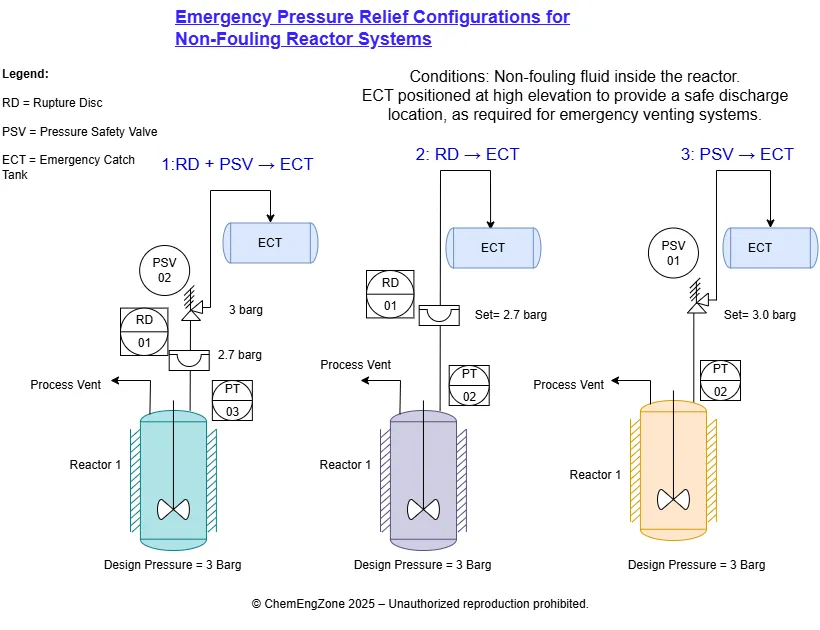
In this case, the reactor’s emergency relief line is connected to an elevated Emergency Catch Tank (ECT), ensuring a fully open discharge path to the atmosphere.
The only device installed on the ECT vent is a flame arrestor, required when the external atmosphere may represent a potential ignition source.
Below are three typical configurations for the reactor’s emergency relief line:
• Rupture Disc + PSV → ECT
• Rupture Disc only → ECT
• PSV only → ECT
Each configuration responds to specific operational and engineering requirements, which we will analyze in detail in the following sections.
1. Rupture Disc + PSV → ECT
This configuration installs the two devices in series and is typically selected when the process fluid is expected to foul, corrode, or deposit solids that could compromise PSV performance over time.
In practice, the rupture disc acts as a physical barrier between the process and the valve, allowing the PSV to operate under controlled, relatively “clean” conditions.
Advantages of this configuration
- By isolating the PSV from the process, the rupture disc prevents corrosion, solidification, and sticking.
- Near-zero leakage is ensured until the disc bursts, minimizing the risk of PSV seat leakage.
- The PSV operates in a cleaner environment, increasing reliability and reducing spurious openings.
- Once the pressure drops below the blowdown, the PSV automatically recloses. This is a key advantage in scenarios where the system stabilizes quickly after the initial relief.
Operational and Design Implications
• Requires more space, additional flanges, and higher installation complexity.
• Long or elevated vent lines increase friction losses and static head.
As a result, when total backpressure approaches or exceeds ~10% of the PSV set pressure, the valve may open sluggishly, fail to achieve its rated capacity, or exhibit unstable behavior such as chatter.
(According to API 520/521)
• When a rupture disc is installed upstream, the disc and its holder introduce additional inlet losses.
According to API 520, inlet line losses must remain <3% of the PSV set pressure to avoid delayed lift or instability.
• Liquid carryover into a gas-sized PSV can cause erratic opening or insufficient capacity. In such cases, the relief philosophy must be revised (knockout pot, liquid seal, liquid PSV, etc.).
• If the rupture disc bursts, replacement is required before the original protection arrangement can be restored. In high-value continuous plants, this can become an important consideration, because disc activation may lead to interruption of normal operation and significant economic consequences.
2. Rupture Disc Only → ECT
In this configuration the disc is the sole protection device. It offers extremely fast response, simplicity, and perfect tightness, but no modulation. Once it bursts, protection is immediate but irreversible.
Advantages of this configuration
• Instant response with no moving parts.
• No leakage up to the burst point.
• Easy integration of burst detection sensors.
• No routine maintenance.
Operational and Design Implications
• Once the disc bursts, the discharge is fully open and cannot be controlled; the reactor must be stopped.
• If pressure continues to rise after activation, there is no possibility to modulate the relief: the system remains fully open and the discharge cannot be regulated.
• No reclosing capability: once the disc has burst, the system stays fully open to the emergency line.
• If the rupture disc is installed too high or too far from the vessel, hydrostatic head and line losses can slow the pressure build-up at the disc, creating a time lag before it bursts.
3. Pressure Safety Valve (PSV) Only → ECT
This is the simplest solution and the most common where the process fluid is not particularly critical. The valve opens gradually, recloses, and allows the operation to continue after the event.
Advantages
• Controlled and progressive opening.
• Automatic reclosing.
• Ideal for slow contingencies, such as pool fires or gradually increasing pressures.
• Simple layout and low complexity.
Operational and Design Implications
• Potential leakage risk, especially with volatile or corrosive fluids.
• Sensitive to deposits, fouling, or sticky fluids.
• In many plants no opening signal is installed, making it difficult to know whether the PSV has operated.
Conclusion
Choosing between a Pressure Safety Valve and a rupture disc is an engineering decision, not a theoretical one.
Each solution — PSV, rupture disc, or a combined configuration — becomes correct only when it reflects the actual process behavior, pressure dynamics, and plant layout.
There is no “best” device in absolute terms, only the right one for that specific operating scenario.
⬆️ Back to TopPSV vs Rupture Disc – Engineering Quiz
In which situation is a rupture disc generally the most appropriate primary pressure relief device?
Other Articles You May Find Useful
- Rupture Disc Installation: Where to Place It
- Rupture Disc Activation: Near Miss or PS Event
- Vacuum Tank Collapse in Atmospheric Tanks
- What Is HAZOP Analysis? Example and Template
- Vent Header Design: Safer Top Tie-In Layout
Useful External Links
CCPS – Center for Chemical Process Safety
Authoritative guidance on process safety, hazard identification, risk analysis, and relief system engineering practices.
UK HSE – Process Safety Guidance
Technical guidance on process safety management, risk reduction, and good engineering practice in industrial plants.
FAQ
What is the purpose of using a rupture disc instead of a PSV?
A rupture disc provides instantaneous opening, perfect tightness under normal operation and is immune to fouling.
It is preferred when extremely fast response is required, or when the process fluid could damage the internals of a PSV.
Often, rupture discs and PSVs are installed together in a combined configuration.
How often should pressure safety valves be inspected?
Inspection frequency depends on process conditions, equipment criticality and internal company standards.
In most industrial plants, PSVs are function-tested or serviced periodically to ensure proper operation and to prevent issues like fouling or leakage.
What determines backpressure in a PSV?
In most cases, PSV backpressure is a system effect, determined by downstream piping resistance, connected equipment, and the overall vent header configuration.
What determines backpressure for a rupture disc?
For rupture discs, backpressure is entirely a system effect.
It comes from downstream piping resistance, including line length, fittings, flame arresters, scrubbers, vent headers, and any condensate present.
Because a rupture disc does not modulate, backpressure does not create stability issues as it would for a PSV.
Instead, it directly affects the pressure differential required for rupture, meaning that high downstream pressure can delay disc activation or alter the effective burst behavior.