
Purging, Inerting, and Blanketing in the Chemical Industry
In industrial practice, you will hear statements like:
“We purged the reactor because the substance is sensitive to oxygen.”
“The vessel was inerted before introducing the flammable solvent.”
“The tank is blanketed with nitrogen during storage.”
These sentences may sound similar, but they describe completely different situations.
In the first case, the objective is to protect the process.
In the second, the objective is to control explosion risk.
In the third, the objective is to maintain stable conditions over time.
Gas handling inside process equipment is always linked to a specific objective.
How Purging Is Actually Performed
To estimate oxygen concentration reduction for each purging method, you can use the dedicated engineering tools available here: Nitrogen Purging and Inerting Calculators
Purging means replacing the gas inside equipment with another gas. It may be used to reduce oxygen before handling flammable substances, but also for process requirements, such as protecting oxygen-sensitive materials.
Vacuum Purging
The equipment is first evacuated using a vacuum system, removing most of the gas inside. After that, nitrogen is introduced to refill the volume.
This operation is repeated several times. Each cycle reduces the amount of oxygen remaining inside the system.
In some industrial applications, vacuum cycles are followed by a pressure step with nitrogen. This is often useful not only for atmosphere replacement, but also for checking the tightness of flanges, connections, and other potential leak points.
A slight positive pressure is usually more practical for leak checking, because any loss tends to move outward and can be detected more easily. Under vacuum, small leaks often result in air ingress from outside, which may be less obvious during routine operations.
This method is effective because it removes gas instead of relying only on dilution. In many industrial cases, vacuum purging is used when low oxygen levels must be reached in a controlled way.
Pressure Purging
Pressure purging is carried out by introducing gas into the equipment up to a defined pressure and then venting it.
During pressurization, the incoming gas mixes with the gas already present inside the system. When the equipment is vented, part of that mixture is removed.
By repeating this operation, the concentration of the original gas is reduced step by step. Pressure purging may be applied either as a standalone method or together with vacuum cycles, depending on the process requirements and equipment design.
The gas used is often nitrogen, but not always for example, in systems handling hydrogen, helium is sometimes used for pressure testing and purging steps. Helium is lighter and has a higher diffusivity, which makes it more effective for detecting small leaks. This is particularly important in hydrogen service, where even minor leaks can be critical.
Compared with vacuum purging, pressure purging works by dilution, so more cycles may be required to reach low oxygen levels.
Continuous Flushing (Dilution Purging)
Continuous flushing is performed by introducing a gas into the system while venting at the same time. The incoming gas mixes with the gas already present, gradually reducing its concentration.
This method is often applied to vessels, especially when cyclic methods such as vacuum or pressure purging are not practical.
Displacement purging
Displacement purging is generally described as a gas replacement technique in which the incoming inert gas pushes the existing gas out of the system with limited mixing.
This behavior is more likely when the flow can be directed from one end of the system to the other and when the geometry supports a defined path.
It may be applied both in pipelines and in vessels. In large tanks without agitation, displacement conditions may be approached when flow is controlled and density differences support stratification between the incoming inert gas and the gas already present in the system.
What Inerting Means
Inerting refers to a condition inside the equipment.
A system is considered inerted when the oxygen concentration is low enough that combustion cannot occur, even if flammable vapors are present.
This condition is usually evaluated with reference to the limiting oxygen concentration (LOC), which is the minimum oxygen level below which combustion of a given flammable atmosphere cannot be sustained.
The LOC depends on the substance present and on the operating conditions. In practice, the target oxygen concentration is often set below the LOC to provide an additional safety margin.
Different operating methods may be used to reduce the oxygen concentration inside the system. However, inerting refers to the final safety condition that must be achieved inside the equipment.
How These Concepts Are Used in Practice
In real plant operations, purging, inerting, and blanketing are not always applied as isolated definitions. They are often part of different operating phases carried out on the same equipment, depending on the process objective.
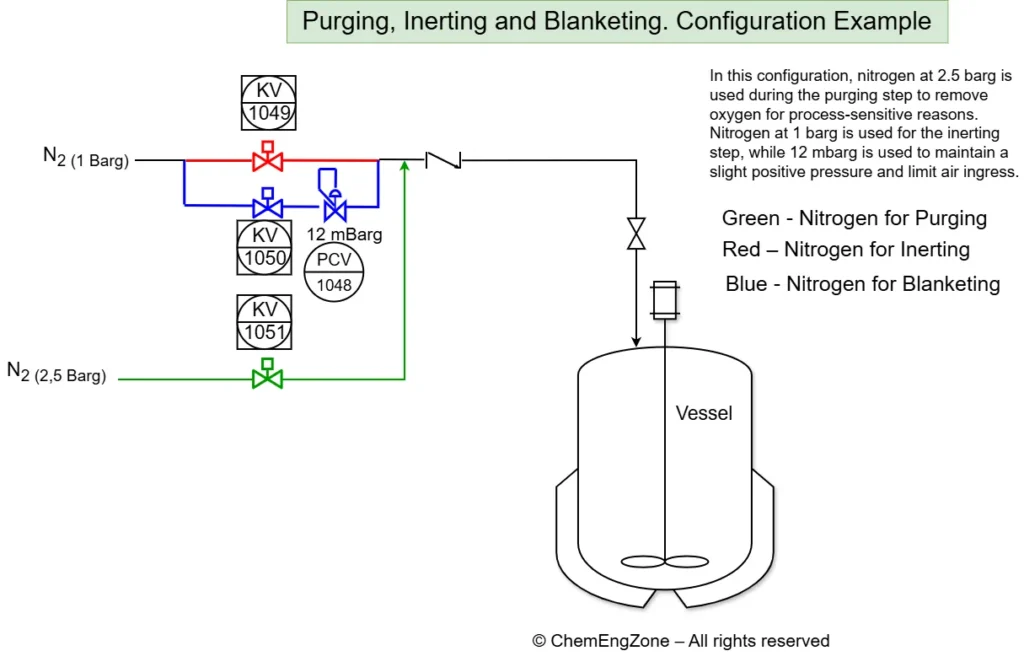
Figure 1 shows one possible configuration in which the same vessel is connected to different nitrogen lines at different pressures. Each line is activated through an on-off valve identified as KV, so that the required operating mode can be selected. The blanketing line is also equipped with a pressure control valve (PCV), which automatically regulates the nitrogen pressure at about 12 mbarg in order to maintain a slight positive pressure inside the vessel.
In this example, nitrogen at 2.5 barg is used during the purging step because the product is oxygen-sensitive. Nitrogen at 1 barg is used for the inerting step, while the low-pressure line regulated by the PCV is used during blanketing to limit air ingress during normal operation or storage.
In this plant, the standard practice for process equipment was to inert by vacuum and nitrogen refill, using the 1 barg nitrogen line for make-up after each cycle.
For this reason, the pressure values shown in the figure should not be read as fixed definitions of purging, inerting, or blanketing. They simply illustrate one possible configuration in which the same nitrogen utility is managed through different pressure levels, on-off valves, and a dedicated pressure control valve, depending on the operating objective.
Conclusion
Purging is the operation used to replace the gas inside the system.
Inerting defines whether the atmosphere is safe from a flammability point of view.
Blanketing is used to maintain the required internal atmosphere over time.
These concepts are closely related in practice, which is why they are often confused. However, understanding the difference is essential to know when each one is used and what purpose it serves.
Need to estimate vacuum cycles, pressure purging steps, or nitrogen flushing time? Use the engineering calculators available here: Nitrogen Purging and Inerting Calculators.
⬆️ Back to TopPurging vs Inerting Quiz
What is the main difference between purging and inerting in industrial practice?
Other Articles You May Find Useful
- Rupture Disc Activation: Near Miss or PS Event
- ATEX Zone Classification: Gas, Vapour & Mist
- Rupture Disc Installation: Where to Place It
- Pressure Safety Valve vs Rupture Disc: Key Differences
- Vent Header Design: Safer Top Tie-In Layout
- Control Valve Leak and System Isolation
- Vacuum Tank Collapse in Atmospheric Tanks
- The 4 Pillars of a Safety Management System
Useful Engineering References
Linde – Nitrogen Purging and Inerting
Practical industrial reference on nitrogen use for purging, inerting, and blanketing applications.
NFPA 69 – Explosion Prevention Systems
Technical reference for inerting, oxidant concentration control, and explosion prevention principles.
FAQ
Is purging only related to inerting?
No. Purging is not limited to inerting. It is used to replace or dilute the gas inside equipment for both safety and process purposes, such as reducing oxygen concentration or removing contaminants.
Is blanketing used for inerting?
Blanketing is not normally the main method used to inert equipment initially. However, it can help maintain the inerted condition over time by reducing air ingress and keeping a stable internal atmosphere.
How is equipment typically inerted in practice?
In practice, inerting is often achieved through a combination of steps rather than a single method. A typical approach may include vacuum and nitrogen refill followed by a pressure step or pressure purging. The selected method depends on equipment design, operating conditions, and the required oxygen level. In some cases, the pressure step is also used as an opportunity to check system tightness before operation.
Is displacement purging the same as flushing?
No. Displacement and flushing describe different flow behaviors.
Displacement assumes that the incoming gas pushes the existing gas out with limited mixing, while flushing relies on mixing and dilution to reduce concentration.