
Head Loss in Pipes: Hagen–Poiseuille Equation
A one-page visual explanation of pressure loss in laminar pipe flow.
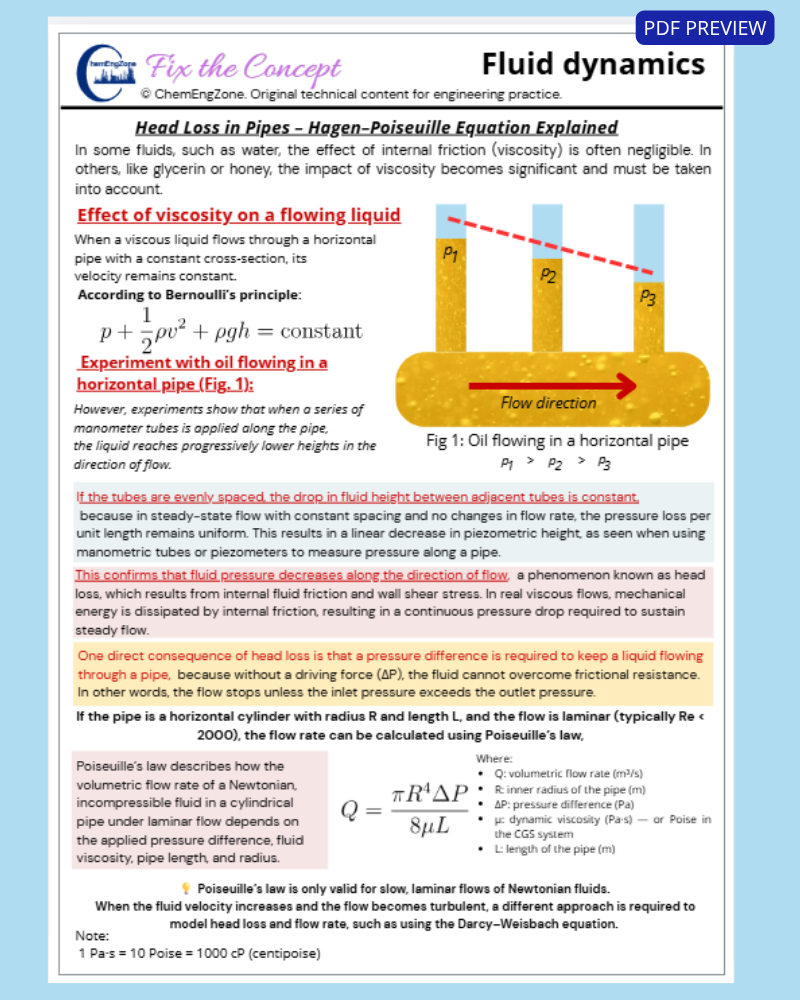
Shows how viscosity affects flow resistance and how the Hagen–Poiseuille equation is applied in practice.
Get the Reference Sheet
A one-page engineering summary showing how viscosity drives pressure loss in laminar pipe flow, useful as a quick calculation reference.
Other Articles You May Find Useful
- Fluid Dynamics Basics for Engineers
- The Law of Poiseuille and Laminar Pipe Flow
- Bernoulli’s Principle: Equation & Applications
- Bernoulli Principle Example: Venturi Meter
- 5 Things to Know About Reynolds Number
- What is Heat Transfer? Definition and Types
🔗 Useful External Links
AIChE – Chemical Engineering Progress (CEP)
Practical publication covering fluid flow, process design, and engineering practice.
Perry’s Chemical Engineers’ Handbook – McGraw Hill
Standard reference for fluid flow, transport phenomena, and engineering fundamentals.
FAQ
How is Poiseuille’s Law used in engineering design?
Engineers use it to estimate laminar pressure drops in small-diameter tubing, capillary viscometers, and heat exchanger circuits, where Reynolds numbers are below 2300 and viscosity dominates over inertia.
Why does Poiseuille’s Law not apply to turbulent flow?
In turbulence, momentum transfer occurs mainly through eddies, not viscosity. The velocity profile flattens, invalidating the parabolic assumption. Friction must instead be calculated with empirical correlations like Darcy–Weisbach.
How does Poiseuille’s Law relate to blood flow?
It was originally derived for capillary blood flow, but real blood is non-Newtonian and shear-thinning. Hence, the law approximates reality only in large vessels or under low shear rates.
Why is Poiseuille’s Law important in chemical engineering?
Because many industrial operations involve viscous laminar flow (e.g., polymer transport, oil pipelines, lubrication systems), understanding viscous head loss is crucial for pump sizing, energy balance, and safety design.