Head Loss in Pipes – Hagen–Poiseuille Equation Explained
A one-page visual explanation showing how viscosity causes pressure loss in laminar pipe flow.
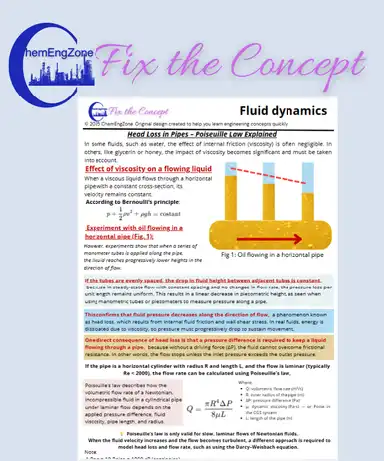
Hagen–Poiseuille Equation (Free PDF)
One-page technical explanation of the Hagen–Poiseuille equation, showing how viscosity causes pressure loss in laminar pipe flow. Designed as a compact reference for engineers.
🔗 Useful External Links
AIChE – Chemical Engineering Progress (CEP)
Monthly journal by the American Institute of Chemical Engineers, featuring best practices in process design, optimization, and plant operation.
OSHA – Process Safety Management Guidelines
Official U.S. resource outlining key safety requirements for chemical and industrial plants.
Chemical Engineering Magazine (ChemEngOnline)
Leading publication covering industrial case studies, plant optimization, and process technologies.
Engineering Toolbox
Comprehensive database with thermodynamic properties, process diagrams, and equipment data for engineers.
Perry’s Chemical Engineers’ Handbook – McGraw Hill
The standard reference for chemical and process engineers worldwide, covering theory, design, and safety.
Other Articles You May Find Useful
- The Law of Poiseuille and Laminar Pipe Flow
- Fluid Dynamics Basics for Engineers
- Bernoulli’s Principle: Equation&Applications
- Chemical Engineering Core Disciplines – A Practical Overview
FAQ
How is Poiseuille’s Law used in engineering design?
Engineers use it to estimate laminar pressure drops in small-diameter tubing, capillary viscometers, and heat exchanger circuits, where Reynolds numbers are below 2300 and viscosity dominates over inertia.
Why does Poiseuille’s Law not apply to turbulent flow?
In turbulence, momentum transfer occurs mainly through eddies, not viscosity. The velocity profile flattens, invalidating the parabolic assumption. Friction must instead be calculated with empirical correlations like Darcy–Weisbach.
How does Poiseuille’s Law relate to blood flow?
It was originally derived for capillary blood flow, but real blood is non-Newtonian and shear-thinning. Hence, the law approximates reality only in large vessels or under low shear rates.
Why is Poiseuille’s Law important in chemical engineering?
Because many industrial operations involve viscous laminar flow (e.g., polymer transport, oil pipelines, lubrication systems), understanding viscous head loss is crucial for pump sizing, energy balance, and safety design.