What the Law of Poiseuille Describes
The law of Poiseuille is one of the first relationships engineers encounter when analyzing fluid flow in pipes.
It describes the behavior of laminar, viscous-dominated flow and shows how pressure drop, fluid viscosity, and pipe geometry are linked to the resulting volumetric flow rate.
While simple in form, Poiseuille’s law is often misapplied outside its domain of validity, leading to incorrect conclusions when used for turbulent flow, large-diameter lines, or industrial piping systems.
Understanding what the law of Poiseuille really describes — and what it does not — is essential for engineers working with pressure losses, flow measurement, and preliminary hydraulic calculations.
Poiseuille and Bernoulli: Different Physical Models
In previous articles on fluid dynamics, the fundamental concepts used to describe fluid motion were introduced. Steady flow, streamlines, and mass conservation were analysed, together with the relationship between pressure, velocity, and elevation described by Bernoulli’s principle for ideal fluids.
Bernoulli’s equation explains how mechanical energy is redistributed in an ideal, inviscid flow. Poiseuille’s law extends this framework to real fluids by accounting for viscous dissipation and by quantifying the energy that must be continuously supplied to maintain motion.
When viscous effects are taken into account, pressure no longer remains constant along a pipe, even when velocity and geometry do not change. This is the physical context in which Poiseuille’s law applies.
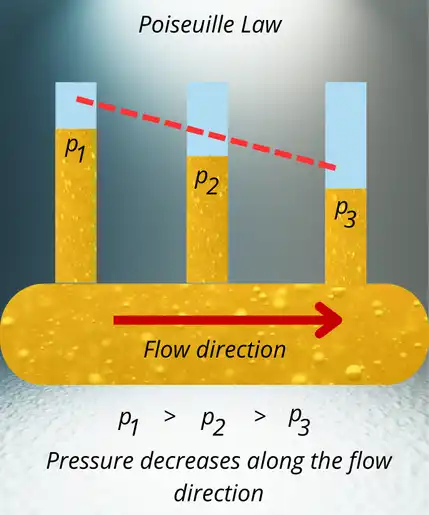
Pressure Loss in Laminar Pipe Flow
Figure 1 illustrates this behaviour for a steady laminar flow in a horizontal pipe with constant cross-section. Static pressure measured by piezometers decreases progressively along the flow direction, such that p₁ > p₂ > p₃.
The pressure decrease shown in the figure is not a transient effect and is not caused by changes in velocity or elevation. The flow is steady, and the pipe geometry remains unchanged along its length. The pressure gradient exists solely because viscous forces continuously dissipate mechanical energy as the fluid flows. To maintain steady motion, this energy loss must be compensated by a continuous pressure drop along the pipe.
Effect of viscosity on real fluids
Viscosity generates internal friction both between adjacent fluid layers and between the fluid and the pipe wall. This internal friction continuously dissipates mechanical energy as the fluid flows.
As a consequence, pressure cannot remain constant along the pipe. A progressive pressure decrease is required to compensate for viscous energy losses and to maintain steady motion.

Access the FREE PDF – Poiseuille Law Visual Explanation
Download a one-page A4 visual summary explaining why pressure decreases along a pipe in laminar flow. The PDF illustrates viscous energy dissipation, head loss, and the physical meaning of the law of Poiseuille using clear diagrams and engineering reasoning.
Continue to Access the PDFThis behavior is directly observable using piezometers along a horizontal pipe: evenly spaced pressure taps show a linear drop in fluid height, indicating uniform head loss in steady laminar flow.
Head loss in steady pipe flow
The progressive pressure decrease along the pipe is known as head loss.
In laminar flow:
- the pressure gradient is constant
- head loss is proportional to fluid viscosity
- the loss is distributed uniformly along the pipe length
This regime allows an exact analytical solution.
Hagen–Poiseuille equation
The law of Poiseuille, often referred to as the Hagen–Poiseuille equation, was independently derived by Gotthilf Hagen and Jean-Léonard-Marie Poiseuille and describes laminar flow of a Newtonian fluid in a circular pipe.
If the following conditions are satisfied:
- Newtonian fluid
- incompressible flow
- fully developed laminar regime
- Reynolds number typically Re < 2000
- pipe length much larger than its diameter
the volumetric flow rate can be calculated using Poiseuille’s law:
where:
- = volumetric flow rate
- = pipe radius
- = dynamic viscosity
- = pipe length
- = pressure drop
This equation shows the strong dependence of flow rate on pipe radius and viscosity.
To sustain this steady flow despite viscous energy dissipation, an external energy input is required. In practical systems, this energy is supplied by a pressure difference generated by devices such as pumps.
Engineering relevance
Law of Poiseuille explains why:
- small pipe diameters cause large pressure losses
- viscous fluids require significantly higher pumping power
- laminar flow is highly sensitive to viscosity
When flow becomes turbulent, this model is no longer valid and empirical correlations such as Darcy–Weisbach must be used.
Conclusion
Poiseuille’s law provides a clear physical interpretation of laminar pipe flow in real fluids. Unlike ideal flow models, it shows that viscosity continuously dissipates mechanical energy, making a pressure gradient unavoidable even in pipes with constant cross-section and steady velocity.
From an engineering standpoint, this law highlights the dominant role of viscosity, pipe length, and especially pipe radius in determining pressure losses and pumping requirements. The strong dependence on radius explains why small geometric changes can have a disproportionate impact on flow rate and energy consumption.
Although its validity is limited to fully developed laminar flow, Poiseuille’s law remains a fundamental reference. It establishes the conceptual bridge between ideal fluid dynamics and real industrial piping systems, and it provides the foundation upon which more general pressure-loss models are built when turbulence or complex flow conditions arise.
Ing. Ivet Miranda
Law of Poiseuille – Engineering Quiz
According to the law of Poiseuille, a liquid flows steadily through a long horizontal pipe with constant diameter under laminar conditions. Why does pressure continuously decrease along the pipe?
Related Process Safety & Risk Analysis Articles
- Fluid Dynamics Basics for Engineers
- Bernoulli’s Principle: Equation&Applications
- Chemical Engineering Core Disciplines – A Practical Overview
- First Law of Thermodynamics and Joule Experiment
- Second Law of Thermodynamics: PM 2nd Kind
Useful External Resources
CCPS – Center for Chemical Process Safety
Leading authority on process safety, layers of protection and industrial risk analysis.
ISA – Safety Instrumented Systems (IEC 61511 Overview)
Clear explanation of SIS, interlocks, SIL concepts and functional safety principles.
API Standards – Pressure-Relieving Systems (API 520 / 521)
Reference standards for rupture discs, pressure relief design and vent systems.
FAQ
What is Poiseuille’s law in simple terms?
As shown above, Poiseuille’s law relates pressure drop, viscosity, and pipe geometry in laminar flow conditions.
What is the difference between steady flow and ideal flow?
Steady flow refers to a condition where fluid properties at a given point do not change with time.
Ideal flow is a simplified model that assumes steady motion, incompressibility, and zero viscosity. A flow can be steady even if it is not ideal.
Can pressure decrease along a pipe even in steady flow?
Yes. In real fluids, pressure can decrease along the flow direction due to viscous energy dissipation, even when velocity and pipe cross-section remain constant. This situation is described by Poiseuille’s law.
Why does Bernoulli’s equation not predict pressure loss in pipes?
Bernoulli’s equation is derived for ideal, inviscid flow and assumes no mechanical energy dissipation. Pressure losses due to viscosity are therefore not captured by Bernoulli’s principle.
Does steady flow mean that pressure is constant along the pipe?
No. Steady flow means that pressure at a given point does not change with time, not that it is the same at all locations. Pressure may vary spatially while remaining constant in time.
What is the difference between Bernoulli and Poiseuille law?
Bernoulli’s equation describes the conservation of mechanical energy in an ideal, inviscid flow, where viscous effects are neglected. It explains how pressure, velocity, and elevation are related along a streamline when no energy is dissipated.
What is the difference between Darcy’s law and Poiseuille’s law?
Darcy’s law describes fluid flow through porous media, such as packed beds, soils, or filters. It relates the volumetric flow rate to the pressure gradient through an empirical permeability coefficient that depends on the porous structure.
Poiseuille’s law applies to laminar flow in a single, straight circular pipe and provides an analytical relationship between pressure drop, viscosity, pipe geometry, and flow rate.
While Poiseuille’s law is derived from first principles under well-defined assumptions, Darcy’s law is a macroscopic, empirical model used when flow occurs through complex internal geometries that cannot be described as a single pipe.