Four Pillars of SMS: Safety Management System Explained
Understand the key elements of a Safety Management System.
Download the Safety Management System PDF – 4 Pillars Infographic
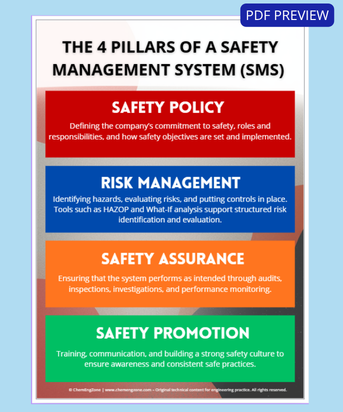
Download a concise infographic explaining the four pillars of SMS for training and technical reference. The PDF will be sent instantly to your email after registration.
Other Articles You May Find Useful
- The 4 Pillars of a Safety Management System
- What Is HAZOP Analysis? Example and Template
- Safety Interlocks in Chemical Plants: P&ID Example
- Rupture Disc Activation: Near Miss or Process Safety Event
- Pressure Safety Valve vs Rupture Disc: Key Differences
- ATEX Zone Classification: Gas, Vapour & Mist
- Vacuum Tank Collapse in Atmospheric Tanks
Useful Engineering References
OSHA – Process Safety Management (PSM)
Official guidance on process safety management for chemical plants.
CCPS – Center for Chemical Process Safety
International reference organization focused on process safety and risk reduction.
FAQ
What are the four pillars of SMS?
A Safety Management System is commonly structured around four core pillars: Safety Policy, Risk Management, Safety Assurance, and Safety Promotion. Together these elements define how safety objectives are established, how hazards are identified and controlled, how system performance is monitored, and how safety culture is maintained across the organization.
What is the purpose of a Safety Management System?
The purpose of a Safety Management System is to systematically control operational risks. Instead of reacting to accidents, an SMS provides structured processes to identify hazards, evaluate risk, implement safeguards, and monitor safety performance over time.
What are the key elements of a Safety Management System?
Key elements of a Safety Management System include a clear safety policy, structured risk assessment processes, monitoring of safety performance, incident and near-miss analysis, and continuous improvement mechanisms. These elements ensure that safety is integrated into daily operations rather than treated as a separate activity.
Why are the 4 SMS pillars important?
The four pillars ensure that safety management is balanced across strategy, technical risk control, performance monitoring, and organizational behavior. Without this structure, safety programs often become fragmented and fail to influence real operational decisions.