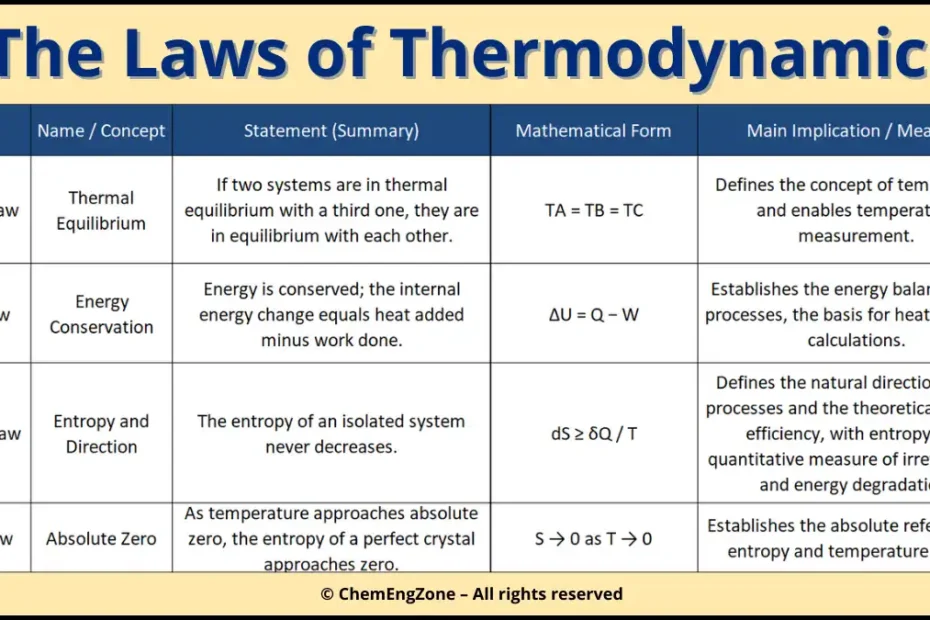
The 4 Laws of Thermodynamics
The four laws of thermodynamics establish the physical boundaries of engineering systems, defining equilibrium, energy conservation, irreversibility, and absolute entropy.

The four laws of thermodynamics establish the physical boundaries of engineering systems, defining equilibrium, energy conservation, irreversibility, and absolute entropy.
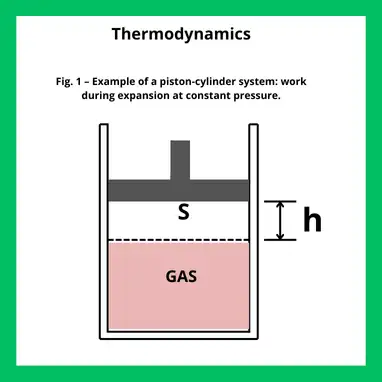
Thermodynamics work describes the mechanical energy exchanged between a system and its surroundings during a transformation. From piston expansion to cyclic processes, it is represented in P–V diagrams as the area under the curve or enclosed by the cycle, making it a key concept for applying the First Law of Thermodynamics.

The Second Law of Thermodynamics governs the direction and irreversibility of real processes, completing the energy balance framework established by the First Law.
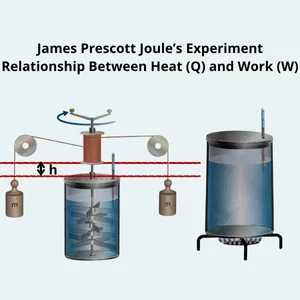
Joule’s experiment demonstrates the equivalence between mechanical work and heat, providing the experimental foundation of the First Law of Thermodynamics and the concept of internal energy.