Thermodynamics Reference Sheet PDF (A3)
The essential thermodynamic concepts, organized the way engineers actually use them.
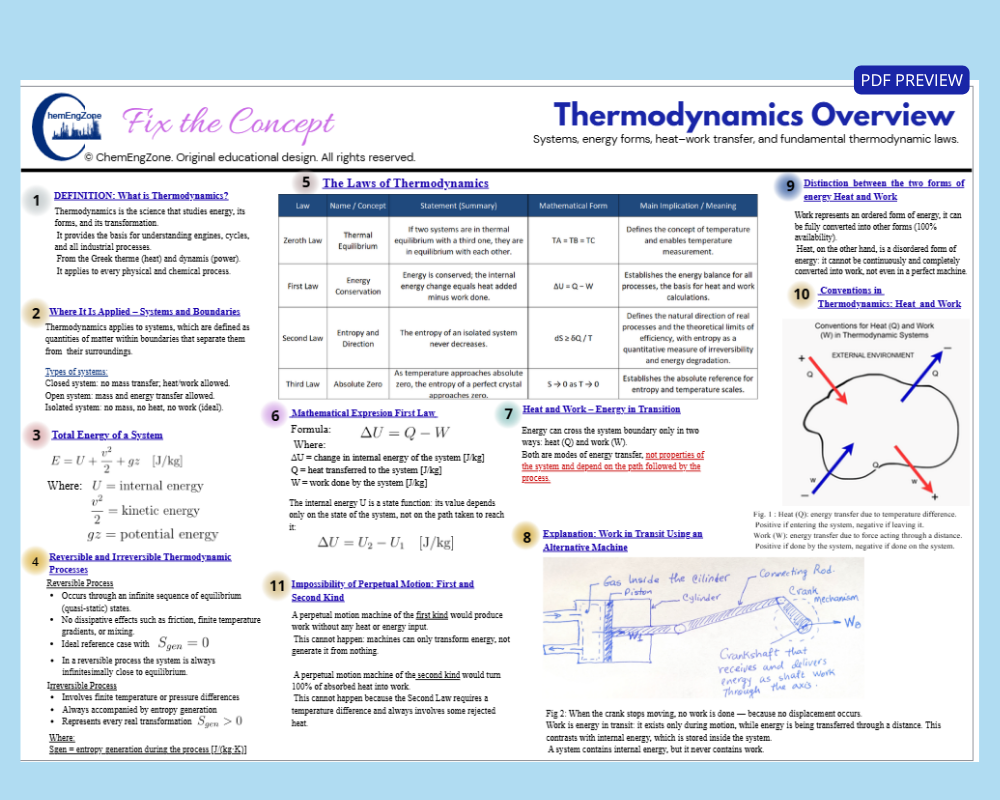
Thermodynamics Overview – Free PDF
A concise engineering reference covering energy balance, heat transfer, and system behavior under real operating conditions.
Other Articles You May Find Useful
- Joule’s Experiment & 1st Law of Thermodynamics
- The 4 Laws of Thermodynamics
- Second Law of Thermodynamics: PM 2nd Kind
- Work in Thermodynamics. PV Diagrams
- What is Heat Transfer? Definition and Types
- Chemical Engineering Core Disciplines – A Practical Overview
Useful Engineering References
MIT OpenCourseWare – Thermodynamics
Structured course material covering the fundamental principles of thermodynamics and engineering applications.
NIST – Thermodynamics Resources
Reference data and technical resources on thermodynamic properties and energy systems.
FAQ
Is this a laws of thermodynamics PDF? What’s included?
It summarizes the 4 Laws of Thermodynamics, system types and boundaries, energy forms, heat vs work conventions, reversible vs irreversible processes, and Second Law concepts (Carnot cycle and Clausius inequality).
What is a thermodynamic system, and why does the boundary matter?
A system is the part you analyze; the boundary defines what can cross it (heat, work, and possibly mass). That choice drives the correct form of the energy and entropy balances.
What’s the real difference between heat (Q) and work (W)?
Both are energy in transit across the boundary. Heat transfer is driven by temperature difference; work is energy transfer associated with generalized forces (e.g., P–V boundary work, shaft work).
Why does the Second Law require two temperature reservoirs for a heat engine?
A heat engine needs a hot source and a cold sink. Without a cold sink, you cannot reject heat and the cycle cannot deliver continuous net work.
What is the Clausius inequality, in simple terms?
It formalizes irreversibility. For real cycles, the inequality shows that you cannot “get back” all heat as useful work—irreversibilities impose a penalty (entropy generation).
What does “reversible process” mean, and why do engineers use it?
Reversible is an ideal limit (no gradients, no friction, no dissipation). Engineers use it as a benchmark to estimate maximum efficiency and understand how far a real process is from the limit.
Thermodynamics overview PDF: how to access the free download
You can access the free A3 thermodynamics review PDF through the form on this page. The download link is provided after email confirmation.