Rupture Discs in Pressure Protection Systems
Rupture disc installation requires correct positioning relative to the protected equipment.
Disc location influences pressure transmission, activation behavior, and the overall performance of the pressure relief system.
This article examines the engineering principles behind rupture disc positioning in reactor systems, comparing close-to-nozzle and elevated configurations and defining technical criteria for sound design decisions.
Positioning affects inlet pressure drop, backpressure sensitivity, condensate accumulation, accessibility, and discharge safety.
These factors must be evaluated when designing or reviewing a pressure relief system to ensure reliable activation and effective protection under real operating conditions.
Rupture Disc Positioning Options: Close-to-Nozzle vs Extended Inlet Line
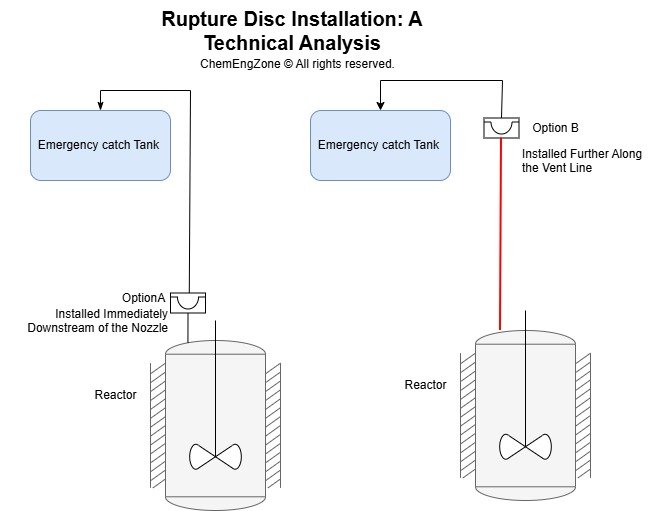
The schematic shows a vertical pressure vent line connected to a reactor, with two alternative rupture disc installation layouts.
Option A installs the rupture disc immediately downstream of the vessel nozzle, minimizing the inlet section between the reactor and the device.
Option B installs the disc further along the vent line, increasing the inlet line length and creating an intermediate section upstream of the rupture disc.
Both configurations are designed to relieve reactor overpressure. The downstream catch tank is intended to contain material released upon disc rupture.
Hydraulic Considerations
The distance between the protected equipment and the rupture disc directly affects the hydraulic behavior of the relief system.
A shorter inlet section limits friction losses and ensures that vessel pressure is transmitted to the disc with minimal attenuation. Increasing inlet line length introduces additional pressure drop, which may influence the effective differential pressure acting on the device during an upset.
The impact depends on flow regime, line diameter, fittings, and service conditions. Elevation alone is not the determining factor; the equivalent inlet length and associated pressure losses are.
Intermediate Volume and Drainability
When the rupture disc is positioned further from the vessel, an intermediate volume is created between the protected equipment and the device.
If this section is not self-draining or properly sloped, it may accumulate condensate or solids. In vapor service, condensation can partially obstruct the line. In multiphase or contaminated systems, deposits may form over time.
Such conditions can alter pressure transmission or introduce uncertainty in activation behavior.
Backpressure Effects
Rupture discs respond to differential pressure.
The pressure acting on the downstream side of the disc influences the effective burst condition.
Longer vent lines or connected downstream systems may introduce built-up or variable backpressure. When combined with inlet pressure losses, this may reduce the effective burst margin under upset conditions.
Proper evaluation therefore requires considering both upstream and downstream hydraulic conditions.
Engineering Evaluation
The selection of rupture disc location should be based on calculated inlet pressure drop, assessment of intermediate volume behavior, drainage capability, and downstream backpressure conditions.
In many cases, installing the disc as close as practicable to the vessel simplifies the hydraulic configuration. However, where space, accessibility, or structural constraints require relocation, the hydraulic impact must be verified rather than assumed.
Mechanical Integrity and Maintenance
Extended or difficult-to-access inlet sections can complicate inspection, rupture disc replacement, and tell-tale or burst indicator monitoring. Limited accessibility may delay detection of damage, corrosion, or improper installation, affecting long-term reliability.
GMP and Cleaning Considerations
In GMP-regulated or hygienic processes, the inlet section between the reactor and the rupture disc may also raise quality-related considerations.
If this segment is not included in cleaning validation (e.g., CIP/SIP cycles) or is not self-draining, it may behave as a dead leg where product residues accumulate. Over time, this can promote degradation, polymerization, or microbial growth, depending on the service.
While this does not directly affect pressure relief performance, it may introduce compliance and product quality concerns that must be evaluated during layout design.
Conclusion
Installing the rupture disc as close as practicable to the protected equipment reduces inlet pressure losses, limits intermediate volume, and simplifies hydraulic behavior.
Configurations involving extended inlet sections introduce additional pressure drop, backpressure sensitivity, and drainage considerations that require verification through calculation and layout review.
Rupture disc positioning is therefore a hydraulic and operational design decision that directly influences protective performance and should be evaluated with the same rigor applied to device selection and relief capacity sizing.
Ing. Ivet Miranda
⬆️ Back to TopRupture Disc Positioning Quiz
Which hydraulic factor most strongly supports installing a rupture disc close to the vessel nozzle?
Related Process Safety Articles
• Pressure Safety Valve vs Rupture Disc: Key Differences
• Rupture Disc Activation: Near Miss or PS Event
• Vacuum Tank Collapse in Atmospheric Tanks
• Vent Header Design: Safer Top Tie-In Layout
• What Is HAZOP Analysis? Example and Template
FAQ
Does rupture disc installation location affect activation performance?
Yes. Rupture disc installation position influences inlet pressure drop, intermediate volume, and differential pressure transmission. These factors can affect how quickly and reliably the disc activates during an overpressure event.
Can a rupture disc be installed higher along the vent line?
Yes, but hydraulic effects must be evaluated. Extended inlet length may introduce additional pressure losses, intermediate volume, and sensitivity to downstream backpressure.
Is elevation the main factor in rupture disc installation?
No. Elevation alone is not decisive. The critical parameters are equivalent inlet length, pressure drop, drainage capability, and downstream backpressure behavior.
Why is minimizing inlet line length important in rupture disc installation?
Short inlet sections reduce friction losses and help ensure accurate differential pressure transmission to the device, supporting predictable burst behavior during upset conditions.