
ATEX Zone Classification Chart PDF
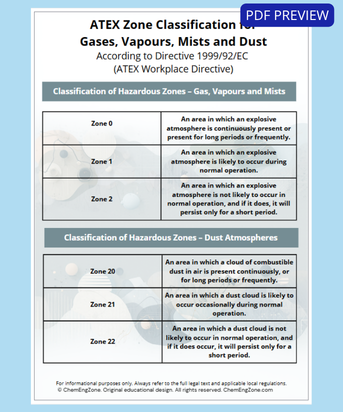
A practical reference chart explaining ATEX hazardous area classification for gases, vapours, mists, and dusts. The PDF summarizes Zones 0–2 and 20–22 according to Directive 1999/92/EC for quick engineering review and internal training purposes.
Useful for engineers, HSE teams, and technical training sessions.
Get the Free PDF – ATEX Zone Classification Chart
A quick engineering reference to support hazardous area classification, design checks, and internal training activities.
Other Articles You May Find Useful
- ATEX Zone Classification: How to Apply the Standard
- What-If vs HAZOP For Process Safety
- HAZOP Example: Water Piping Material Compatibility
- Vacuum Tank Collapse: Hazards & Prevention
- Safety Management System: 4 Pillars
- Rupture Disc Position in a Reactor: Best Practices
- Control Valve Leakage: Often Used Upstream
- Heat Exchanger Fouling and Rubby Formation
Useful Engineering References
CCPS – Center for Chemical Process Safety
Reference organization for process safety practices, including inerting, HAZOP, and risk-based engineering decisions.
NFPA 69 – Explosion Prevention Systems
Technical standard covering inerting concepts and oxygen concentration control for explosion prevention.
Perry’s Chemical Engineers’ Handbook
Standard engineering reference for gas behavior, process equipment, and pressure-based calculations.
FAQ
What does ATEX stand for?
ATEX refers to two European Union directives that regulate equipment and safety in explosive atmospheres. The name comes from the French phrase for “Explosive Atmospheres,” but it’s commonly used in all EU languages as a technical term.
How often should ATEX zones be reviewed?
ATEX classifications must be reviewed whenever a change occurs in the plant layout, ventilation, process conditions, or substances handled. Even minor modifications can alter zone boundaries or risk levels.
Does nitrogen blanketing affect ATEX zone classification?
No. The presence of inert gas like nitrogen reduces the risk of ignition, but ATEX zoning is based on the presence and release of flammable substances, not on control measures. Blanketing is considered later during ignition risk analysis, not during zone definition.
Is ATEX zoning mandatory in non-EU countries?
ATEX is an EU regulation, but many countries outside the EU adopt similar standards or refer to IECEx. Multinational companies often align with ATEX to maintain consistency in their explosion protection strategies.
Can dust and gas zones coexist in the same area?
Yes. If both combustible dust and flammable gas are present in a process, overlapping zoning may apply, for example, Zone 1 for gas and Zone 21 for dust. This situation is common in units handling partially dried solids or organic powders. A typical case is the discharge of low-moisture product from a centrifuge or the feeding of a dryer. Equipment in such areas must be certified for both types of explosive atmospheres.
Why is the ATEX classification chart useful?
The ATEX classification chart helps engineers and safety professionals quickly identify zone types and their associated requirements, based on EU Directive 1999/92/EC.
It serves as a practical reference during design, inspections, and risk assessments, especially in early plant layout stages.
Even when inerting systems are used, the chart still applies, because inerting influences the ignition risk, not the classification of the area itself.