
Already familiar with this topic? Test your understanding here.
Go to the quizFundamental Concepts Governing Fluid Flow
Fluid dynamics deals with the description of fluid motion and the forces involved, providing the theoretical foundation for analyzing fluid behavior in engineering systems.
In chemical engineering, this theoretical framework is applied to the study and design of fluid transport operations, which concern the handling, distribution, and control of fluids within industrial plants and are classified as fundamental unit operations.
Ideal Flow as the Reference Model
Fluid dynamics is developed by introducing progressively more complex models.
The starting point is the steady motion of an ideal, incompressible fluid, in which viscous effects are neglected.
Although this model does not represent real fluids in a strict sense, it provides a well-defined reference framework. It allows the derivation of general relations while preserving the fundamental principles of mass and energy conservation.
Within this ideal-flow framework, several concepts are introduced that remain central to all subsequent analyses:
- streamlines and flow tubes, used to describe the geometry of fluid motion;
- flow rate and the continuity equation, expressing mass conservation;
- Bernoulli’s equation, relating pressure, velocity, and elevation in energetic terms.
These concepts are first established under ideal conditions and then extended to more realistic situations, where viscous, compressible, or turbulent effects become relevant.
When viscous effects become dominant, steady pipe flow can no longer be described by ideal-flow assumptions, and pressure losses must be explicitly accounted for, as described by the law of Poiseuille.
Steady Motion of Fluids
The simplest type of fluid motion to analyze is steady flow.
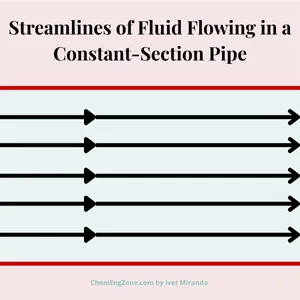
A flow is defined as steady when the properties of the fluid at a given point in space do not change with time.
This means that if we consider a fixed point P inside the conduit, every particle that passes through P will always have the same velocity, pressure, and density.
These values may differ from one location to another in the system, but at each specific point they remain constant over time.
Figure 1 illustrates this situation: fluid flowing in a constant–section pipe under steady conditions. The streamlines are parallel and equally spaced, showing that the velocity profile does not change along the length of the conduit.
This simple case introduces two fundamental ideas:
- in steady motion, the flow field is predictable and reproducible;
- the trajectories of fluid particles can be represented as streamlines, curves tangent to the velocity vector at every point.
Streamlines and Flow Tubes
The trajectories described in Figure 1 are known as streamlines. A streamline represents the path followed by a fluid particle in steady motion, and its tangent at each point corresponds to the local velocity vector.
Streamlines can be visualized experimentally by adding dye to a liquid flow or introducing lightweight tracer particles. These tracers reveal how fluid particles align with the velocity field inside a conduit.
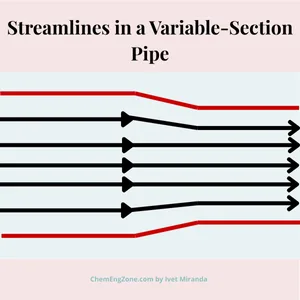
Figure 2 shows the case of a variable–section pipe. Here the streamlines are no longer parallel:
- they become denser where the pipe narrows, indicating higher velocity;
- they spread out where the pipe widens, indicating lower velocity.
This simple observation anticipates the principle of continuity: if the same amount of fluid passes through every section of the pipe, then velocity must increase when the cross–section decreases, and vice versa.
When a family of streamlines passes through the points of a closed curve, they form what is called a flow tube. A flow tube behaves as if it were a real conduit: no fluid crosses its boundaries, and the flow remains entirely confined inside.
Flow Rate and the Continuity Equation

Once the concept of a stream tube is introduced, it is possible to define flow rate.
In the context of fluid dynamics, this quantity represents the volume of fluid that crosses a section of the conduit in a given unit of time.
The idea is simple: consider the volume of fluid contained in a stream tube as it passes through a cross–section in a given unit of time.
For a section S and an average velocity v, the volumetric flow rate is: Q=S⋅v
where:
- Q = volumetric flow rate [m3/s][
- S = cross–sectional area [m2]
- v= average velocity across the section [m/s]
In steady incompressible flow, the volumetric flow rate is the same at every section of the conduit. This condition is expressed by the continuity equation: S1 v1=S2 v2, which shows that velocity is inversely proportional to the cross–sectional area.
Continuity in a Variable-Section Pipe
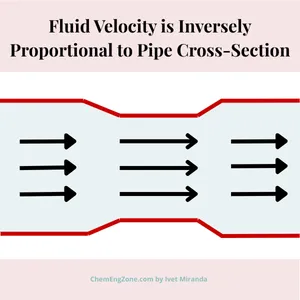
In Figure 4, two sections of the pipe are compared:
- At section 1, the fluid has cross–sectional area S1 and velocity v1.
- At section 2, the fluid has cross–sectional area S2 and velocity v2.
Because the volumetric flow rate must remain constant in steady incompressible flow, the following condition applies: S1v1=S2v2
This equation shows that velocity is inversely proportional to the cross–sectional area. In other words, the fluid accelerates when the pipe narrows and slows down when the pipe widens.
Pressure–Velocity Relationship in Steady Flow
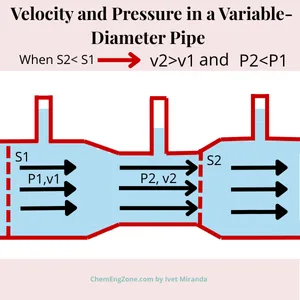
The continuity equation explains that velocity must increase when the cross–section of a pipe decreases. However, experiments with manometers show an additional effect: the static pressure in the constricted region becomes lower than in the wider region.
Figure 5 illustrates this result.
At section 1, the fluid has cross–section S1, velocity v1, and pressure P1. At section 2, where the pipe narrows to S2, the velocity increases to v2 while the static pressure drops to P2.
S2<S1⇒ v2>v1 and P2<P1.
In fluid dynamics, this observation is fundamental because it prepares the ground for the general relation between pressure, velocity, and elevation: Bernoulli’s equation.
Conclusion
These fundamental observations show that velocity, pressure, and geometry are inherently linked in fluid motion.
At this stage, fluid dynamics provides the descriptive tools needed to understand how a flow behaves when conditions change.
The energetic interpretation that explains why these changes occur belongs to the next step of fluid mechanics, where pressure, velocity, and elevation are analysed as different forms of mechanical energy carried by the fluid.
⬆️ Back to TopFluid Dynamics Quiz
In steady incompressible flow through a pipe with varying cross-section, which statement is correct?
Other Articles You May Find Useful
• Bernoulli’s Principle: Equation & Applications
• Bernoulli Principle Example: Venturi Meter
• The Law of Poiseuille and Laminar Pipe Flow
• Unit Operations in Chemical Engineering: Types and Examples
• Chemical Engineering Core Disciplines – A Practical Overview
FAQ
What is the difference between steady and unsteady flow in fluid dynamics?
n steady flow, the velocity, pressure, and density at a given point do not change with time. In unsteady flow, these properties vary with time. Steady flow is the starting point of fluid dynamics because it allows the use of conservation laws in a simple way.
Why does pressure decrease where velocity increases in fluid dynamics?
Because of energy conservation. As velocity increases, the kinetic energy of the fluid rises, and this must be balanced by a reduction in static pressure. This effect is described by Bernoulli’s equation.
What is the difference between volumetric and mass flow rate in fluid dynamics?
The volumetric flow rate (Q=S⋅v) measures the volume of fluid per unit time. The mass flow rate (m=ρQ) measures the mass of fluid per unit time. For incompressible fluids, they are directly proportional. For compressible fluids, mass flow rate is the fundamental quantity.